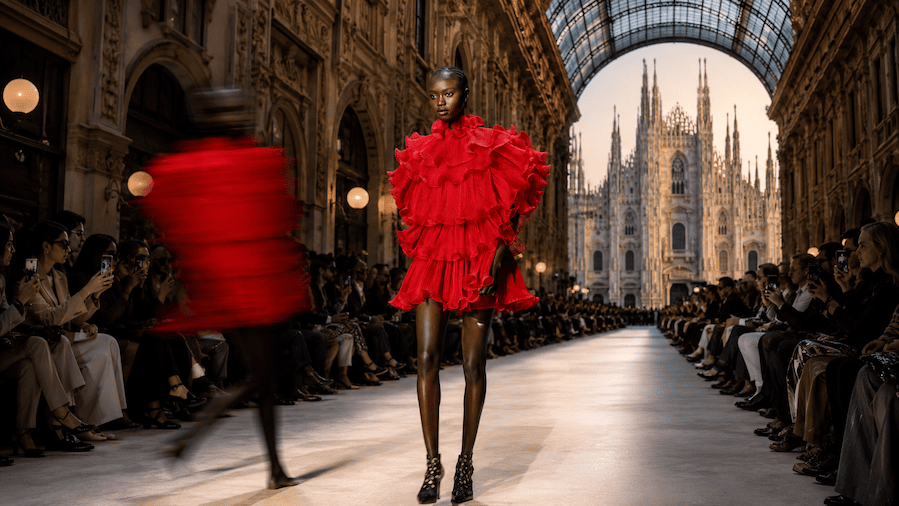
AFTER MILAN, PARIS TAKES THE STAGE

Milan has just switched off the lights and Paris is already under way. The Fashion Week dedicated to Spring/Summer 2027 began on September 28 and runs until October 6, with 68 shows and 33 presentations. Nine days in which practically all the big names of French and international fashion will take the stage.

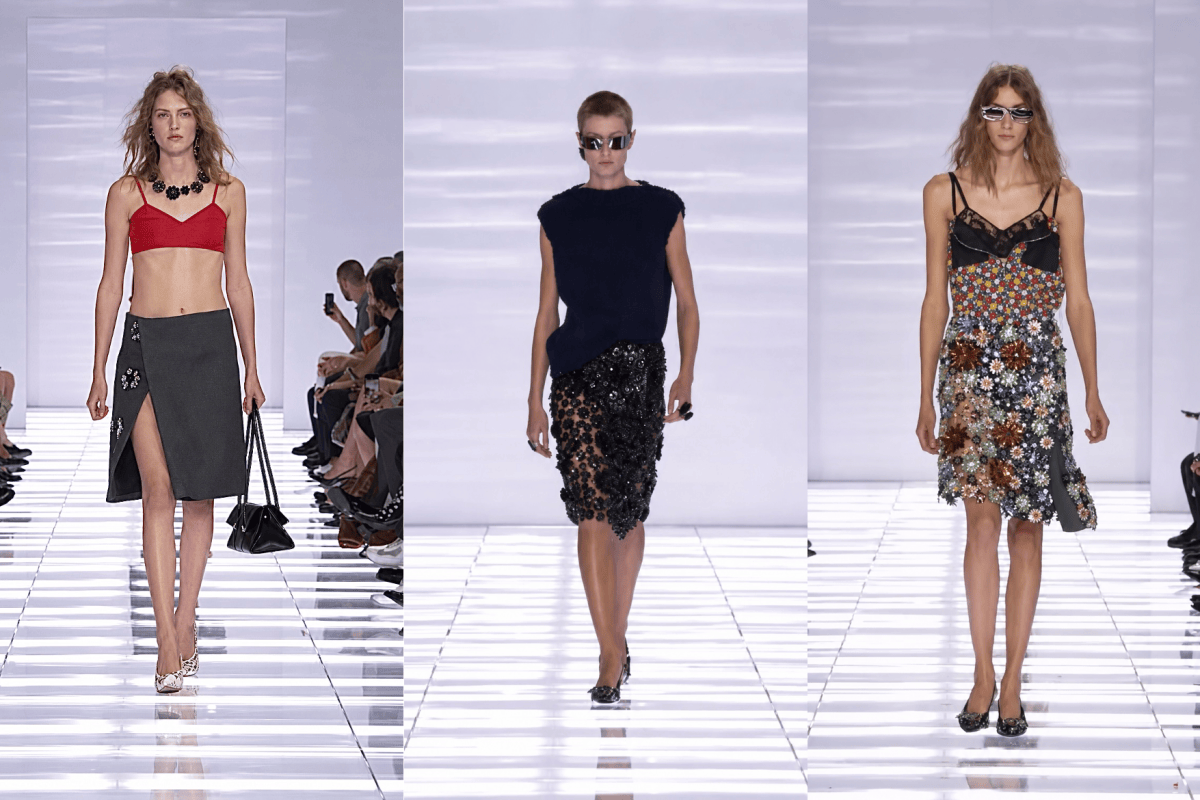
The first day was given over mainly to the new generations; then on September 29 came Dior, Maison Margiela and Saint Laurent, and the tone changed immediately. Dior brought to the Tuileries Jonathan Anderson’s second Spring/Summer, still grappling with an enormous heritage to reinterpret through his own language. In the evening, Anthony Vaccarello turned the Trocadéro into a great golden stage, with the Eiffel Tower in the background, also celebrating his ten years at the helm of Saint Laurent. Two completely different ways of engaging with the history of a Maison.

Paris, after all, has always played a different game. Milan remains closely tied to product, craftsmanship, Made in Italy and brand recognition; here fashion more readily becomes performance, reaching for art, history and sets capable of turning a show into an event. That does not necessarily mean doing better. It means having another way of telling fashion, and that is also why moving from one city to the other continues to make sense.

And we are only at the beginning. The calendar has yet to bring out Balmain, Dries Van Noten, Tom Ford, Schiaparelli, Balenciaga, Loewe, Givenchy, Celine, Hermès, Valentino, Chanel and Louis Vuitton. Big names, and inevitably high expectations.

Now we will see the collections. Because Paris knows how to build a spectacle like few other cities, but once the lights are off and the sets are taken down, what really interests me is understanding what remains of the clothes.


Discover more of Sara’s World

Sara Dal Monte

Sara Dal Monte
Digital Journalist | Photographer | Art Director
Los Angeles • Sure-Com America
Instagram
X
Facebook
Facebook 2
Facebook Page

MILAN FASHION WEEK, THE RUNWAYS GO DARK. WHAT REALLY REMAINS?

Today, September 28, Milan Fashion Week Spring/Summer 2027 officially comes to a close. The major shows are over, and the final day leaves room above all for digital. After seven days and 203 appointments — 61 shows, 88 presentations and 54 events — the question is no longer just what we saw on the runway, but what remains in Milan once the lights go out.

A first figure concerns the city’s power of attraction. Confcommercio Milano estimated almost 141,000 visitors, with a 22% rise in foreign visitors, and an economic impact of €219.5 million: €100.8 million in shopping, €85.4 million in hospitality and dining, and €32.9 million in transport. Significant numbers, even if 8% lower than in September 2025, showing how Fashion Week involves hotels, restaurants, shops, transport and services, well beyond the perimeter of the fashion houses.

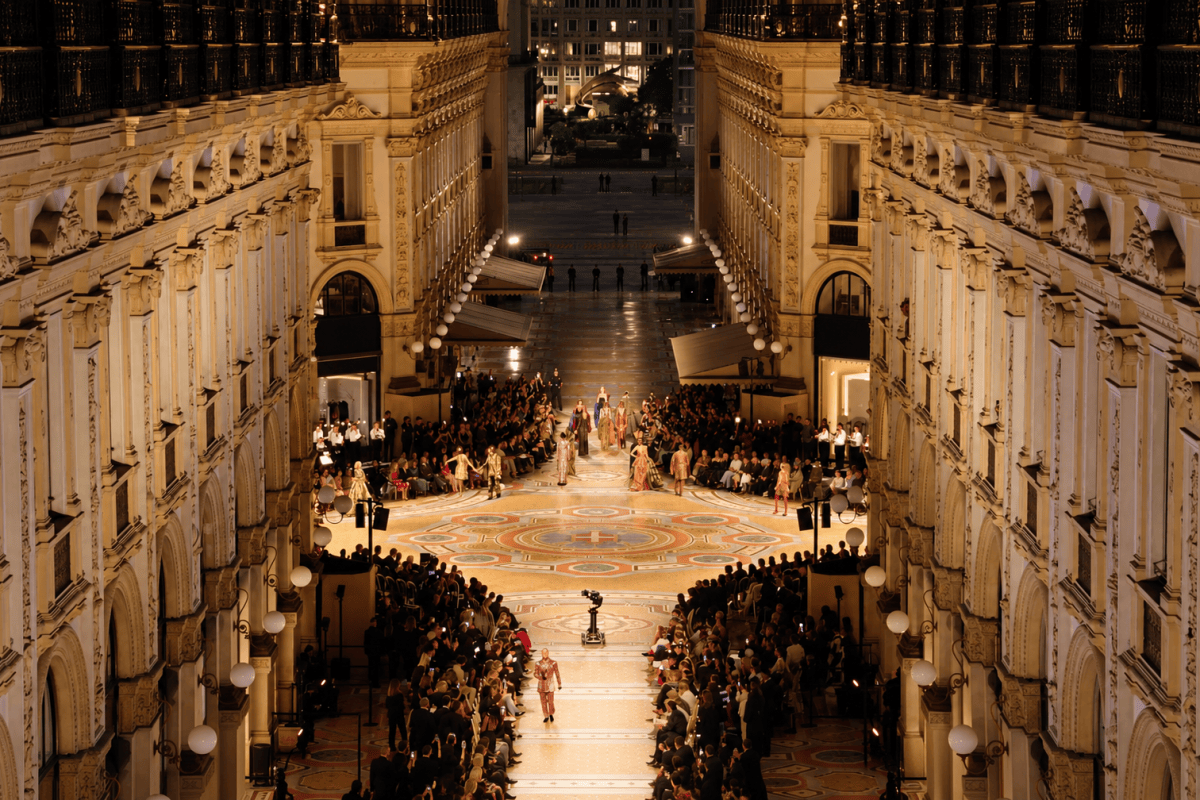
Within this week, Vogue World: Milan was one of the moments of greatest international exposure. The Galleria Vittorio Emanuele II brought together fashion, entertainment, craftsmanship, technology, major maisons and international figures, turning the center of Milan into a global stage for one evening. An event of this scale strengthens the appeal of Fashion Week and the activity surrounding hospitality, dining, transport and shopping. But Vogue World also left something very concrete behind: the fundraising reached $3 million, about €2.65 million, earmarked for the renovation and expansion of the Quarto Oggiaro Library.

Then there are the contacts, the business relationships, the buyers, the international press, millions of images shared around the world and the orders that will continue to be finalized in the showrooms. As we already noted when discussing the positive sentiment expressed by buyers, approval is a first signal. The next step will be to understand how much of it will translate into purchases, and therefore into production.

And this is exactly where institutions should open a reflection. Not only celebrating attendance and visibility, but gathering and analyzing the results: hotel occupancy, dining, shopping, orders, buyers’ countries of origin and the impact on the supply chain. Understanding what worked and where to intervene can turn a week of enormous international exposure into an even more effective tool to support the sector.

Because behind the major fashion houses there is a supply chain made of weaving mills, garment makers, leather goods makers, shoe factories, workshops, artisans, pattern makers, logistics and thousands of small and medium-sized enterprises. This is where Made in Italy generates skills, employment and exports. Fashion Week can become even more of an opportunity to bring international buyers closer to production districts, to support the internationalization of SMEs, training and innovation, and to strengthen the link between runway, market and manufacturing.

Milan has shown once again that it can attract the world. The challenge now is to understand how to turn this attention into value that is ever more widely shared across the city and the entire Italian supply chain.

The runways go dark, but this is exactly when the most interesting work begins: measuring what this week has produced and turning it into growth. Because a Fashion Week is not measured only when it turns the lights on, but also by what it leaves behind when they go out.


Discover more of Sara’s World

Sara Dal Monte

Sara Dal Monte
Digital Journalist | Photographer | Art Director
Los Angeles • Sure-Com America
Instagram
X
Facebook
Facebook 2
Facebook Page

MILAN FASHION WEEK, BUYERS APPROVE. NOW ALL EYES TURN TO ORDERS

Milan Fashion Week Spring/Summer 2027 closes with a positive sentiment. Buyers speak of more concrete, recognizable, product-focused collections, while attendance was particularly high. Carla Cereda of Biffi highlights how consistent the proposals were with their respective maisons; Luigi D’Aniello describes a Milan full of energy and people, so much so that it reminded him of Design Week. Signals confirming that attention around Milanese fashion remains strong.

What emerges above all from the statements gathered by the trade press is a return to the reality of the store. Beppe Nugnes puts the garment and the client at the center: creativity and emotion must generate desire once the product reaches the boutique. Michele Franzese looks at the same point from another angle: the image attracts, but it is fabric, fit, workmanship and value for money that convince the customer.

Among the most appreciated collections, Prada stands out. Daniela Kraler sees the skirt as one of the strongest messages of the season; Federico Giglio credits Miuccia Prada and Raf Simons with consistency and new ideas on product, while Nugnes underlines their ability to make a familiar garment desirable again. D’Aniello considers it the most successful proposal in terms of concept, character and direction.

Praise also for Bottega Veneta, where a more concrete element appears: Cereda states that she intends to buy a lot from the maison, while Nugnes highlights the balance between craftsmanship, texture and lightness. It is not yet data on orders, but here appreciation is already accompanied by a commercial intention.

On Gucci, buyers express favorable opinions. Giglio sees a vision that Demna is progressively defining, Nugnes names Gucci as his favorite show, and Cereda includes it among the proposals that struck her most. These are their assessments and should be recorded as such. I have already expressed my own position on the maison’s new course: exaggerated proportions, extreme oversize, layering and reinterpretations of elements that already belong to Gucci’s history. My question therefore remains the same: beyond exasperation and reinterpretation, where is the new?

Fendi by Maria Grazia Chiuri convinces with its nod to the Seventies, its femininity and its balance between image, craftsmanship and product. Armani is appreciated for elegance and consistency, while Moschino and Max Mara win praise for their ability to reaffirm their presence. Among emerging designers, Franzese points to Francesco Murano and Marco Rambaldi, while reminding us that for a retailer creativity and quality must go hand in hand with production capacity, reliability and on-time delivery.

The picture coming out of Milan is therefore positive: audiences, attention, engaged buyers and greater concreteness. But it is precisely from these assessments that the question the market cares about arises: will this appreciation also translate into growth in orders compared with previous seasons?

Because appreciating and buying are not the same thing. In the first case, you recognize a collection’s potential; in the second, you commit budgets, choose quantities and take on commercial risk. At the moment we do not yet have an overall picture of Spring/Summer 2027 orders, especially international ones, while sales campaigns continue in the showrooms.

Fashion is creativity, image and communication, but it remains an industry. Buyers approve of Milan. Now all eyes turn to orders, to understand how much of this consensus will translate into market.


Discover more of Sara’s World

Sara Dal Monte

Sara Dal Monte
Digital Journalist | Photographer | Art Director
Los Angeles • Sure-Com America
Instagram
X
Facebook
Facebook 2
Facebook Page

DOLCE&GABBANA SS27, WHEN MADE IN ITALY BECOMES STORYTELLING

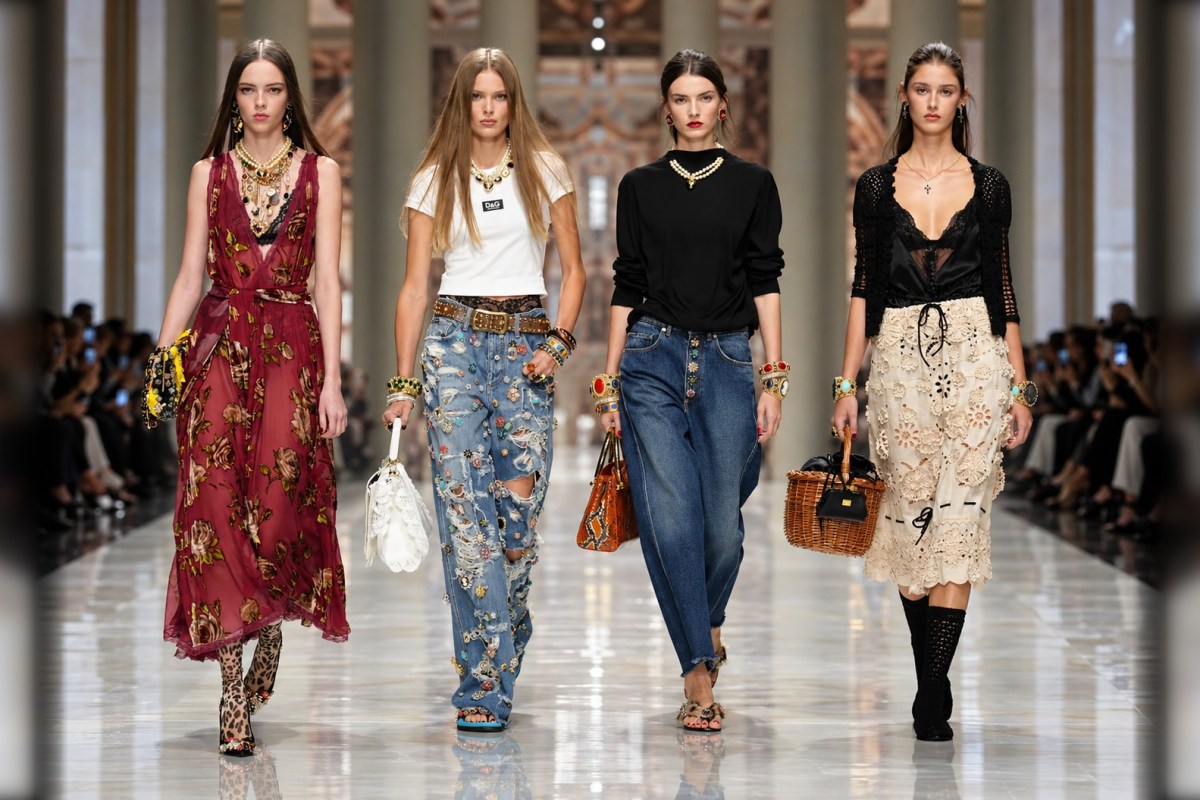
In a Milan Fashion Week marked by changes of creative direction, repositionings and new grammars, Dolce&Gabbana keeps doing something more difficult: remaining recognizable without standing still. The Spring/Summer 2027 collection starts again from a precise aesthetic heritage made of lace, lingerie, black and white, animal prints, statement jewelry, embellished denim, sheer fabrics, embroidery and tailoring. Codes that have long belonged to the work of Domenico Dolce and Stefano Gabbana, but that are constantly reworked, without chasing the new at all costs and without losing that stylistic signature which, over forty years, has become instantly recognizable.

SS27 works a great deal on contrasts. Denim is ripped, embroidered and studded with appliqués until it becomes almost couture; white lace meets black lingerie; gingham, seemingly innocent, is pushed toward an openly declared sensuality; jewels, crosses, stones, embroidery and precious workmanship transform the surfaces and take them far from any apparent simplicity. There is no minimalism, and there could not be. Dolce&Gabbana works through accumulation, contrast and decoration, but behind this richness the construction remains precise: the dress, the jacket, the corset, the embroidery, the jewel and the bag all belong to the same story.

And this is where fashion becomes something bigger. I believe few brands have told the world about Italy with the same force as Dolce&Gabbana. Domenico Dolce and Stefano Gabbana have traveled across the country, bringing collections, Alta Moda and presentations to the cities and places that best represent our beauty. Sicily remains one of the cardinal points of their imagination, but their Italian story is much broader. Inside Dolce&Gabbana there is food, there are markets, flowers, homes, architecture, territories, design, popular religious devotion and craftsmanship. There are lace and embroidery, tailoring and jewelry, handwork and that Italian ability to turn a craft into aesthetic culture.

The images that accompanied this collection before the show also went exactly in that direction: flowers, tomatoes, lace, photographs, jewels, historic interiors. Not simple decorative references, but fragments of an Italy transformed into image, fashion and communication. And this is where the title finds its meaning: for Dolce&Gabbana, Made in Italy is not just a place of origin, nor merely a certification of quality. It becomes storytelling. The storytelling of territories, crafts, traditions, beauty, manufacturing skill and culture.

At a time when many brands seem busy constantly redefining themselves, Dolce&Gabbana instead continues to know exactly where it comes from. This does not mean repeating the past. It means possessing enough creative material to transform it without denying it. For years Domenico Dolce and Stefano Gabbana have been building a narrative of Made in Italy capable of uniting tradition, craft and spectacle. And perhaps this is one of the most important achievements of their work: having made fashion a tool through which to tell the story of Italy.

That is why I continue to consider them among the greatest ambassadors of Italian beauty in the world.

Chapeau to Domenico Dolce and Stefano Gabbana.


GALLERY


Discover more of Sara’s World

Sara Dal Monte

Sara Dal Monte
Digital Journalist | Photographer | Art Director
Los Angeles • Sure-Com America
Instagram
X
Facebook
Facebook 2
Facebook Page

ERMANNO SCERVINO SS27, FEMININITY RETURNS TO CENTER STAGE

Ermanno Scervino brings to Milan Fashion Week a collection that puts back at the center something only seemingly simple: a garment should enhance the person wearing it, not replace her. This is the starting point of the Spring/Summer 2027 collection presented this morning at 10:30 at Piazza Lina Bo Bardi 1, a show built on femininity, on material and on a tailoring that feels no need to deform the body to prove it is contemporary.

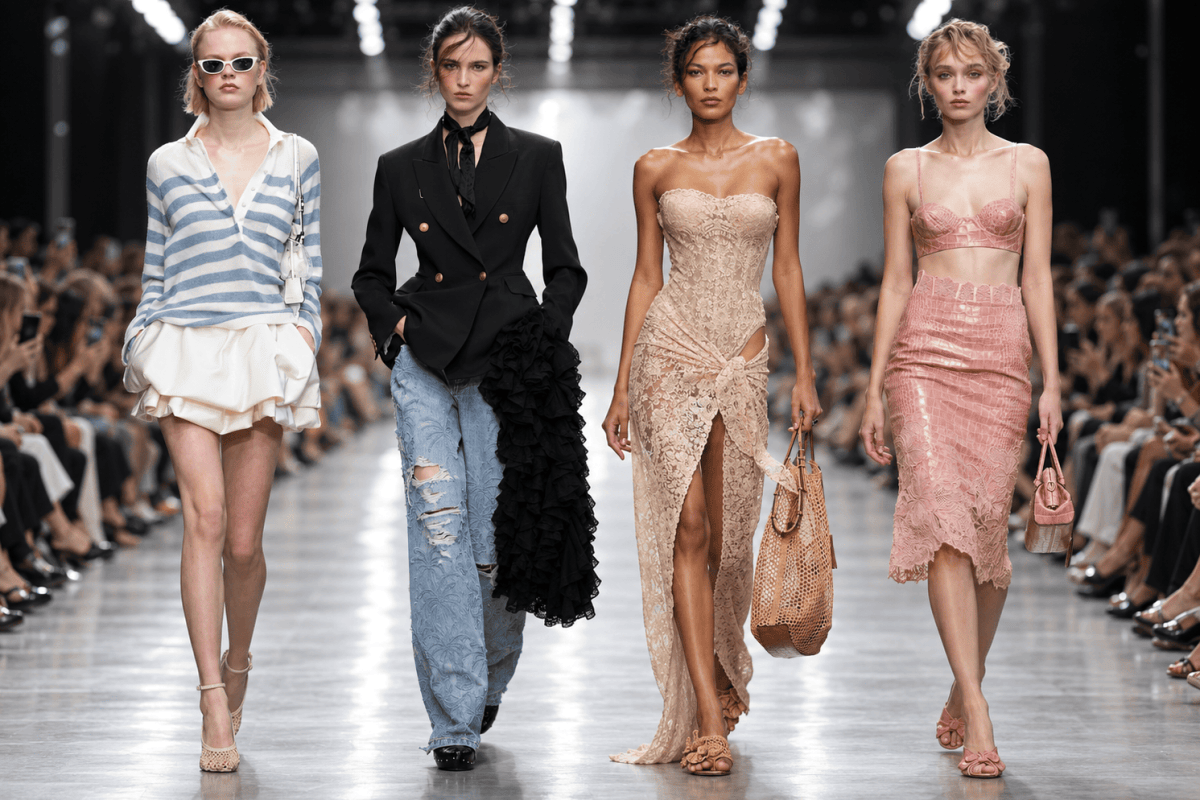
Scervino works on the contrast between structure and lightness with a naturalness that holds the whole collection together. Blazers mark the waist, trousers widen, leather jackets and trench coats provide structure, while lingerie, bustiers, slip dresses, lace and sheer fabrics lighten the design and constantly bring attention back to the body. They are not separate worlds, but two registers that coexist and strengthen each other. Lingerie leaves the private sphere and becomes dress, top, construction; lace is no longer mere ornament but real material, capable of defining a silhouette as much as a well-cut jacket.

Even when the collection reveals a lot of the body, there is never a sense of shouted sensuality. The shorts are short, the bustiers evident, the transparencies declared, but everything stays within a precise control of proportions. Sensuality is not pursued through excess, but through the way the fabric falls, tightens, lets the body be glimpsed, follows movement. This is where Scervino’s work becomes most interesting, because the garment does not take over the woman: it accompanies her and heightens her presence.

Material plays a central role, but it is not exhibited as a technical exercise. Lace, embroidery, crochet, leather, denim, satin and precious workmanship enter the garments without turning the runway into a display of skill. Everything remains at the service of the silhouette. The palette too, from whites and ivories to shades of honey, tan, chocolate, black and powder pink, maintains a visual continuity that makes the collection legible and coherent. Light blues and palm-tree prints introduce a more summery note, but without slipping into the easy resort image.

The point, however, lies elsewhere. A great garment should never ask the person to disappear in order to be noticed. It should do the opposite: increase her presence, give her strength, correct, accompany, enhance. In this show Scervino does so very often, and he does it without needing to build unreal characters. The models remain women, the body remains legible, and femininity is not treated as something to be corrected or demolished.

And this is perhaps the most interesting part of the collection. In a season in which so much fashion keeps seeking the new through exasperation, Scervino chooses to work on beauty without making it banal. He does not give up research, but puts it at the service of the garment and the person. Fashion can be rupture, provocation, experimentation, but it can still have another function too: making a woman feel better in what she wears.


GALLERY


Discover more of Sara’s World

Sara Dal Monte

Sara Dal Monte
Digital Journalist | Photographer | Art Director
Los Angeles • Sure-Com America
Instagram
X
Facebook
Facebook 2
Facebook Page

GUCCI SS27: WHEN EXASPERATION BECOMES LANGUAGE

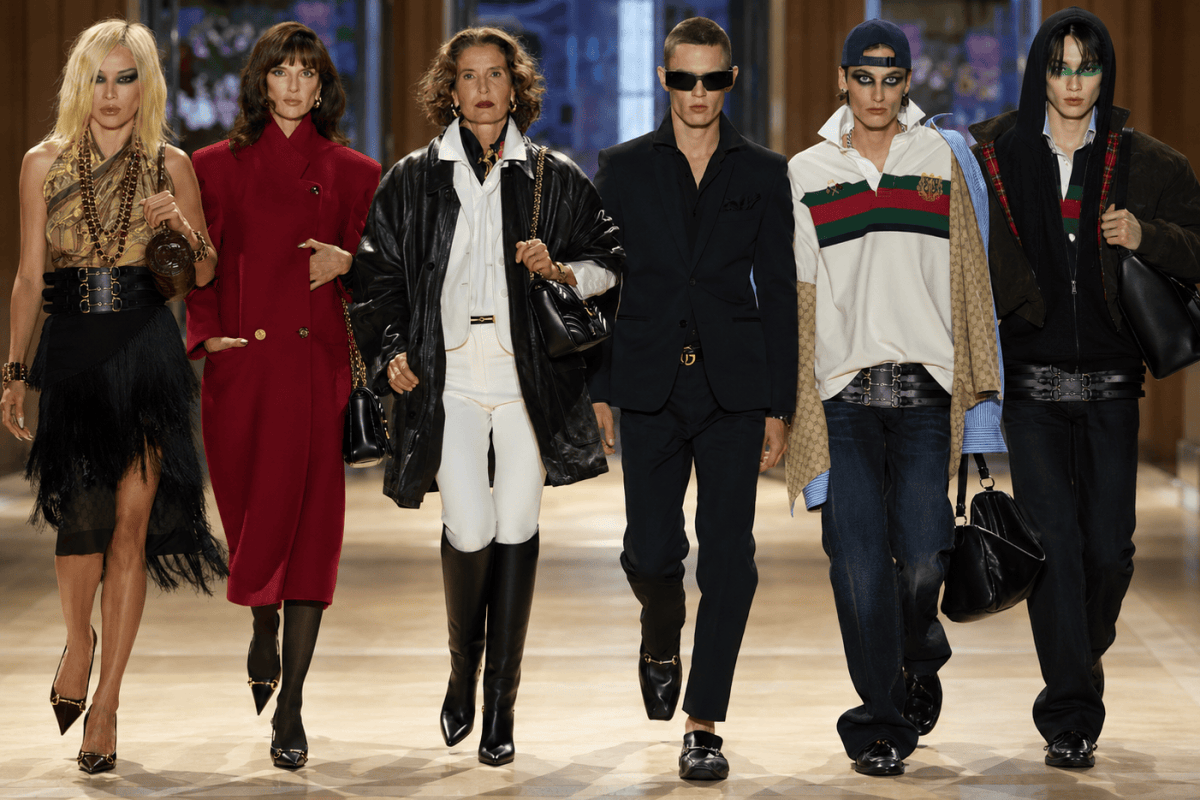
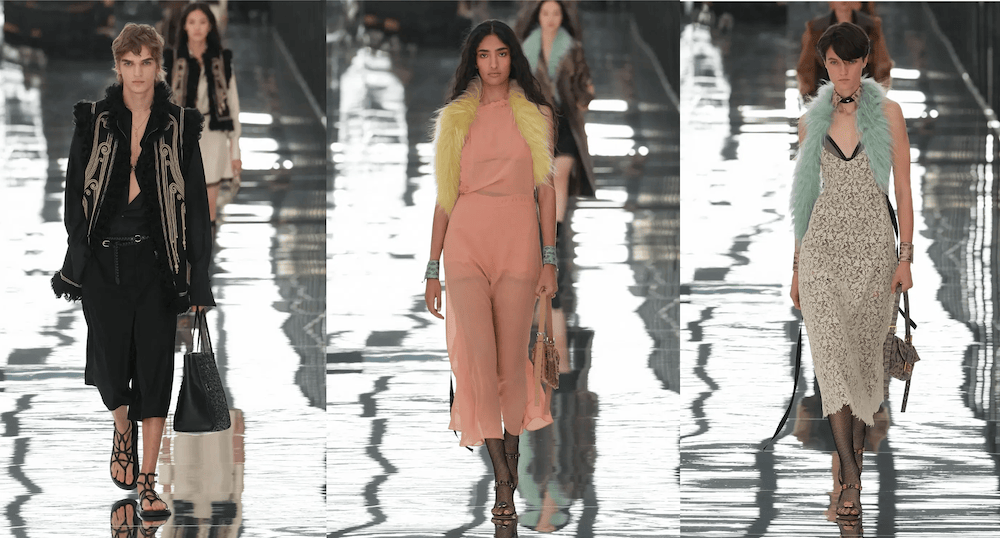
I swear I watched this show several times, because I wanted to understand where Demna wanted to take Gucci. In the end I found a key, and it is very clear: exasperation. Everything is pushed to the limit – proportions, volumes, the body, the very way an image is built. Knitwear becomes enormous and is worn by very thin boys; jackets either widen until they deform the figure or become tight, dry, almost constricting. In menswear especially, the body seems constantly corrected, shifted, diminished, as if the silhouette had to lose its balance in order to gain an identity.

And this is exactly where my problem with this collection begins. Because to exasperate means to bring something to a maximum level of tension, and after tension there necessarily comes a breaking point. Here, instead, I have the feeling that this tension has become the very language of the house, a grammar made of excess, deformation, citation, provocation, archive and constant contrasts, without it ever becoming fully clear what the point of arrival is.

Gucci comes from a different culture. It comes from precision, from construction, from an almost obsessive attention to detail, from leather, from accessories, from the ability to make a jacket, a bag or a shoe desirable without necessarily turning them into a statement. Demna takes this heritage and forces it, stretches it, shifts it, brings it into his own world. His signature is visible, very much so. But precisely because it is so visible, the question becomes inevitable: how much of Gucci remains, and how much are we simply watching Demna applied to Gucci?

In menswear the doubt is even stronger. I see a very young male figure, built almost on a single type of physique and attitude. Targeting that audience is fine – it would be absurd to deny it – but Gucci does not sell only to twenty-year-olds. It also sells to men of forty, fifty, sixty, to a client who may want to be contemporary without turning into a character. And here I struggle to understand where that man has gone.

Then comes the “family”: the boy, the girlfriend, the mother, the aunt, the older lady. I fully understand the desire to tell the story of a transversal brand, capable of crossing generations, but I keep asking myself what the story really is. Because if the common thread is simply taking different eras, different codes, archive pieces, Nineties sensuality, Seventies elements, Eighties volumes and putting them back together by deforming them, then we are not looking at a new vision: we are looking at a continuous reworking of what we have already seen.

I remain puzzled by the womenswear too. Sensuality is part of Gucci’s history and no one questions it, but there is sexy and sexy. There is a sensuality built on proportion, on cut, on a body that is suggested, and there is another that constantly needs to show itself. Here the second path is often chosen. It is a precise choice, but it does not always become elegance, at least not for me.

And so I return to the question I have been asking myself for some time: what are they trying to do with Gucci? Because this is not a small independent label that can afford to turn every collection into an act of protest or a conceptual exercise. This is Gucci. It is a global brand, with a history, a market, clients, investors and an evident problem of desirability to rebuild.

Destroying everything to see what happens next can also be a creative strategy. In fashion it has happened many times, and sometimes it has worked. But destruction alone is not a project. At some point you also have to build something the public wants to desire, wear, buy and recognize as new.


GALLERY


Discover more of Sara’s World

Sara Dal Monte

Sara Dal Monte
Digital Journalist | Photographer | Art Director
Los Angeles • Sure-Com America
Instagram
X
Facebook
Facebook 2
Facebook Page

TOD’S, THE CODE LIES IN THE DETAILS

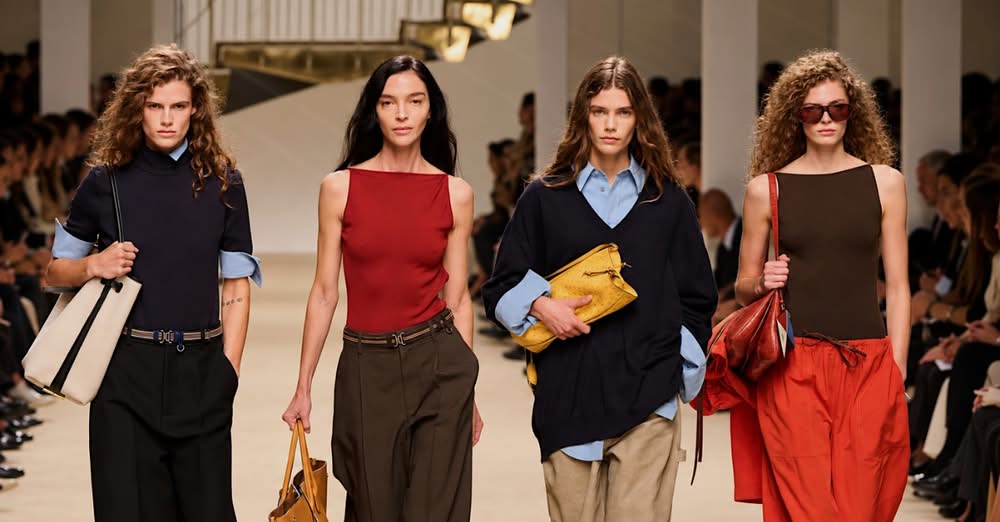
This morning Tod’s opened the day at Milan Fashion Week with Matteo Tamburini’s Spring Summer 2027 collection and, looking at it, the first thing that came to mind was very simple: some brands need to be read, others are understood by the way they are made. Tod’s belongs to the second category. Not because it necessarily has to show a logo or an element recognizable from a distance, but because over time it has built a precise way of working on materials, accessories and proportions. I personally chose these looks because they are the ones I liked most and because, together, they tell this identity well without needing too many explanations.

Tamburini continues to work on a wardrobe that appears simple but is in fact highly controlled. There are wide trousers, Bermuda shorts, trench coats, leather skirts, knitwear, clean dresses and relaxed volumes, yet nothing seems left to chance. That is exactly where Tod’s makes the difference: in the finishes, the bags, the buckles, the shoes, the leathers, in the way an accessory enters the look without seeming added afterwards. I really like this balance, because it avoids that feeling of a collection built to astonish at all costs and instead lets the quality of the project emerge.

Tod’s comes from leather goods and footwear, and that culture is still felt very strongly. The bags have presence but do not weigh down the look, the shoes always seem conceived together with the outfit rather than as an afterthought, and belts and buckles become part of the overall construction. It is a care that shows even when the look becomes softer or more everyday. In fact, perhaps that is where it shows even better, because when you remove the spectacle, the real work remains: the shape, the material, the way a pair of trousers falls, the edge of a jacket, the relationship between a shirt and a bag.

This is what interests me about Tod’s today. Not shouted luxury, but precision. Not effect, but the continuity of a language. Tamburini does not seem to want to turn the brand into something it is not; he is doing subtler work, trying to bring Tod’s craft heritage into a lighter, contemporary and easy-to-wear wardrobe. And in my view the collection works precisely when it manages to do this: keeping the brand’s character recognizable without stiffening it into formulas already seen.

Looking at these looks, the feeling is that Tod’s still has an important advantage: it has a vocabulary of its own. It does not need to explain it from scratch every time. It is enough to observe a bag, a shoe, a buckle, a leather treatment or the cut of a garment to understand that behind it there is a precise product culture. And perhaps this is what I liked most about this morning’s show: the feeling that every detail is there because it serves a purpose, not to fill the stage.


GALLERY


Discover more of Sara’s World

Sara Dal Monte

Sara Dal Monte
Digital Journalist | Photographer | Art Director
Los Angeles • Sure-Com America
Instagram
X
Facebook
Facebook 2
Facebook Page

CAVALLI, THE PLEASURE OF BEING CAVALLI AGAIN

I really liked yesterday’s show, and not only for the clothes. I was glad to find again an atmosphere that belongs deeply to the history of Cavalli: the lights, the set, the very way the show was built around the woman. It brought back the Cavalli I had seen in person many years ago, when Roberto was still there, inside his world and inside the vision he had built and made instantly recognizable.

But today the driving force behind this new image is Fausto Puglisi, and it is right to say so clearly. He is the one who chose to bring Cavalli back to its own archive, to its strongest codes, to the sensuality and visual power that built the identity of the maison. It is a retrospective operation, certainly, but when it is done well it does not become nostalgia: it becomes language.

And it is above all here that I found something that had gradually faded in fashion over recent years: femininity. Puglisi does not try to diminish women, he does not make them awkward, and he does not seem afraid of their beauty. On the contrary, he makes them beautiful, sensual, aware of their own charm. A woman who wears a dress because she enjoys feeling feminine and attractive, and who is not at all uncomfortable being looked at. In fact, she likes being looked at, because she knows she feels good in what she is wearing.

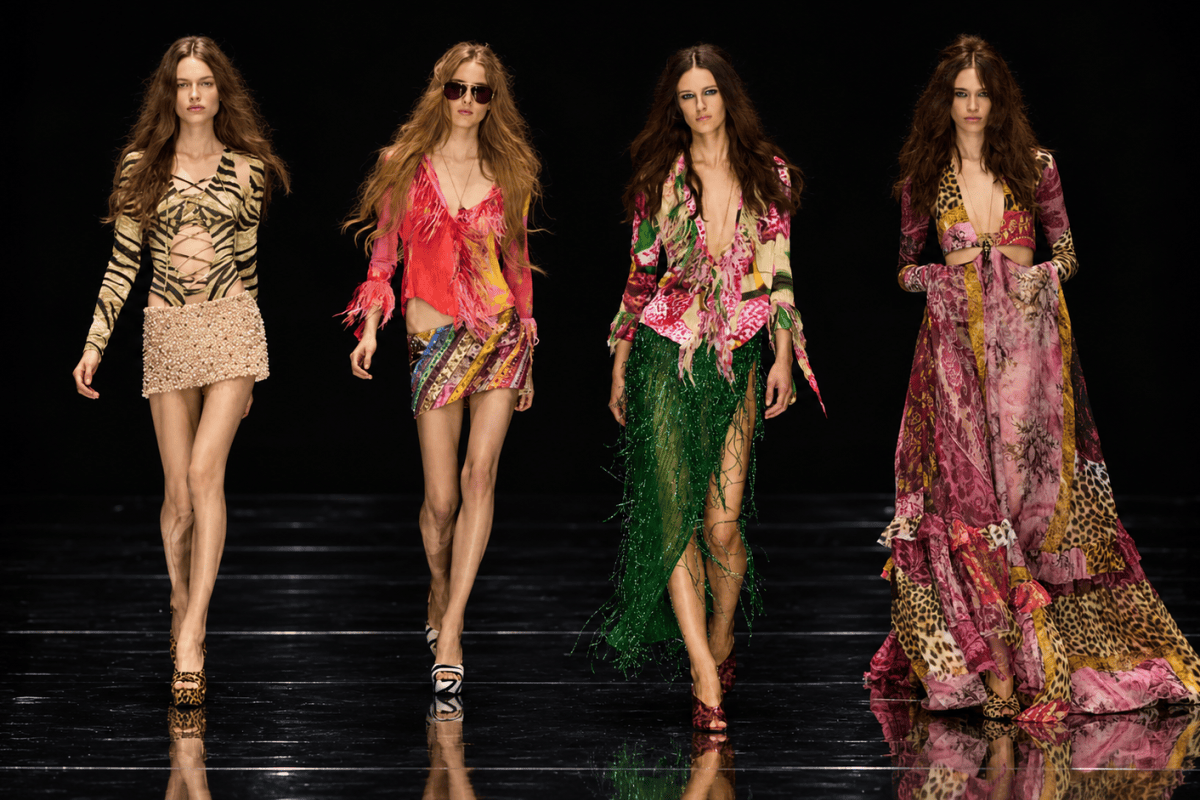
The photographs accompanying this article also come from this reading. They are shots caught in movement, not posed images and not the classic front-facing runway pass. I chose the moments when the subject is unaware of the camera: an expression, a posture, a gesture, the natural movement of the body as the dress follows it. That is often where you understand a garment best, in the way it falls, opens, follows a leg, a shoulder, a twist. They are authentic, unprepared details, and in this collection they show clearly how much Puglisi worked on the dress to enhance the woman’s body, instead of hiding or distorting it.

And then there are the prints. Here Puglisi did, in my opinion, one of the smartest things: he went looking for Cavalli within its own history. Roberto Cavalli, even before becoming the designer known all over the world, was born as an experimenter and a master printer. At Osmannoro, that research had become technique, production, knowledge, craft. Colors, fabrics, leather, processes built up over time. And this is exactly where history cannot be cut off. Because Cavalli is this too.

Losing facilities and skills of that kind means losing not just a production, but a part of the know-how that made Made in Italy great. Textile printing, tailoring, shoemaking, leather, denim: crafts that require time, schooling, and the passing of knowledge from one generation to the next. And which all too often we risk scattering, just as others come to Italy to learn them.

That is why I like what Puglisi is doing. He is not simply recovering an archive. He is recovering the craft, the culture and the origin from which Cavalli was born. He is trying to understand Roberto Cavalli before reinterpreting Cavalli.

Prints, animalier, color, transparencies, denim, fringes, embroidery, dresses that follow the body: Puglisi has put these elements back together without fear of excess. And that is probably exactly what worked yesterday.

Fausto Puglisi looked back, yes. But not out of nostalgia. He looked back to find Cavalli again.


GALLERY


Discover more of Sara’s World

Sara Dal Monte

Sara Dal Monte
Digital Journalist | Photographer | Art Director
Los Angeles • Sure-Com America
Instagram
X
Facebook
Facebook 2
Facebook Page

ETRO, A RUNWAY OF LIGHT, PAISLEY AND LIGHTNESS

Etro brings to the runway a collection that seems to be crossed by light and movement. There is no rigidity, no forced construction.

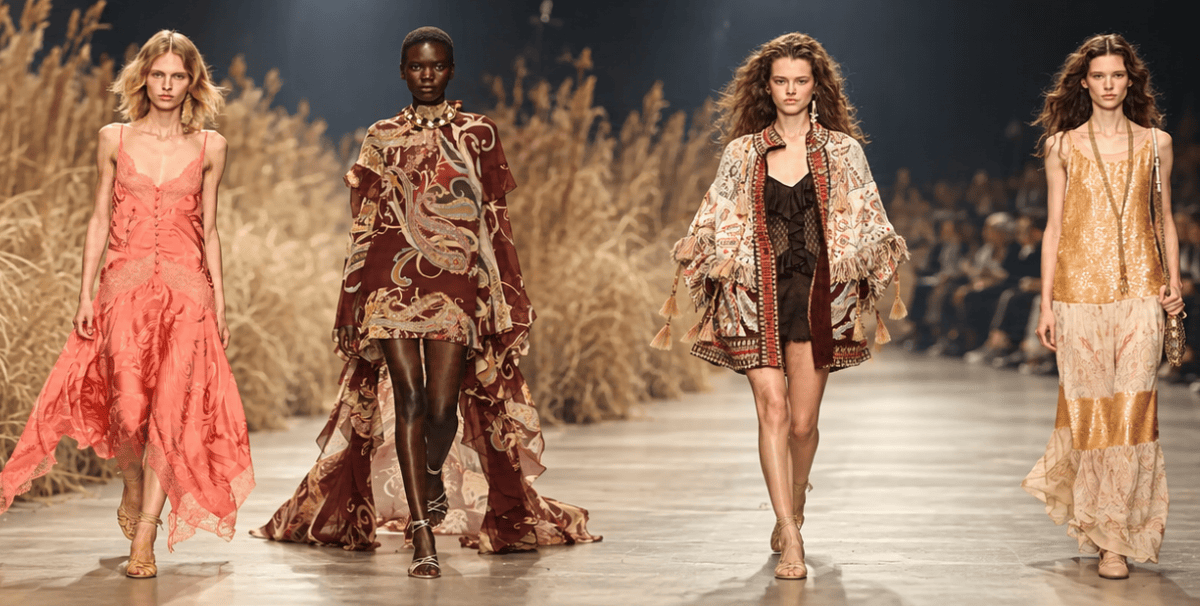
Instead, there is a fluid, soft, almost natural narrative that starts from powdery, very pale tones, moves through copper, coral and wine red, and returns once again to a light, sensual femininity that never shouts.

Among the most successful looks are very pale mini dresses with light trains and impalpable volumes, sheer fabrics that barely touch the body, materials that move like veils, and paisley prints lightened and almost dissolved into the fabric.

Then come dresses in rust-colored sheer lace, printed coral slips, paisley tunics in shades of burgundy, precious knitwear, embroidery and fringes: craftsmanship that keeps alive the decorative language that always remains central at Etro.

The more textured, bohemian passages are also very beautiful: embroidered cardigans, fringed surfaces, luminous sequined dresses, slender elongated silhouettes, all the way to the more revealing looks, almost like a tribal evening wear, where beads, netting and accessories become an integral part of the construction.

Everything flows within an idea of free, nomadic, instinctive elegance, yet held together by a precise signature.

What is interesting is that Etro does not chase effect. Instead, it works on atmosphere, on pace, on the way the clothes sit on the body and move through space.

And that is exactly where the collection finds its best moment.


GALLERY


Discover more of Sara’s World

Sara Dal Monte

Sara Dal Monte
Digital Journalist | Photographer | Art Director
Los Angeles • Sure-Com America
Instagram
X
Facebook
Facebook 2
Facebook Page

MAX MARA, “FAR HORIZON”: SPRING SUMMER 2027

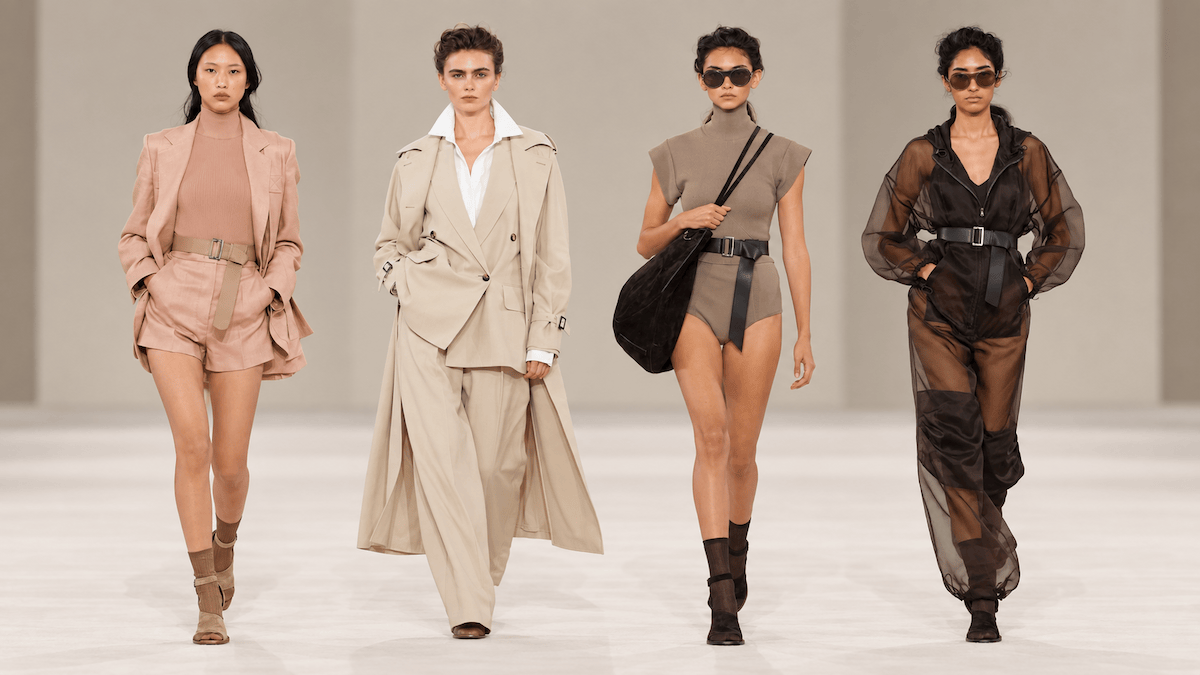
This morning at 9:30, Max Mara presented its Spring Summer 2027 collection in Milan, titled “Far Horizon”. A collection that does not try to rewrite the language of the brand, but to shift its point of view. The work starts once again from what Max Mara knows well and does best: construction, proportions, tailoring, control of form and fit. Here, however, the language becomes lighter, volumes open up and structure enters a more summery dimension without losing precision.

Ian Griffiths, creative director of the house, keeps working on a very strong stylistic signature without turning it into a constant quotation of the archive. It is an important step, especially in a season when many brands are changing direction, creative directors and references. Max Mara does not start from scratch: it works on its own structure and carries it forward.

The collection comes alive through the garments: long trench coats, blazers, wide high-waisted trousers, tailored shorts, white shirts, slip dresses, tops and vests build a very precise wardrobe. The belt returns often and becomes part of the construction: it cinches the waist, breaks up the volumes and defines the proportions. The palette moves between camel, tobacco, sand, taupe, beige, brown, black, white and powder pink, with sharper contrasts entrusted mainly to dark belts, tall boots and essential accessories.

The relationship between structure and lightness is particularly interesting. Tailored fabrics and more compact surfaces are paired with light, sheer, almost weightless materials. Some trench coats keep every element of the classic garment but are emptied of their weight; elsewhere, glossy surfaces, fine knits and more technical constructions appear. Even when the body is revealed through shorts, bodysuits, deep necklines or more fitted dresses, the construction remains controlled.

The looks work very well because they do not feel like runway exercises. These are clothes designed to be worn, with precise proportions and a fit that remains one of the house’s great strengths. “Far Horizon” thus works as a synthesis of the whole: the horizon shifts as you move, but it never disappears. Max Mara does the same: it changes its point of view, lightens, opens up, alters proportions, yet stays within a very clear line.

Spring Summer 2027 thus confirms a precise strategy: moving forward without losing its own measure.


GALLERY


Discover more of Sara’s World

Sara Dal Monte

Sara Dal Monte
Digital Journalist | Photographer | Art Director
Los Angeles • Sure-Com America
Instagram
X
Facebook
Facebook 2
Facebook Page

GENNY, SPRING SUMMER 2027 BETWEEN FLOWERS, SHEER FABRICS AND NEW PROPORTIONS

This morning at 10:30, Genny presented its Spring Summer 2027 collection in Milan under the creative direction of Sara Cavazza Facchini. A collection of 43 looks built on femininity, lightness and decoration, with a very evident work on volumes, sheer fabrics, embroidery and movement.

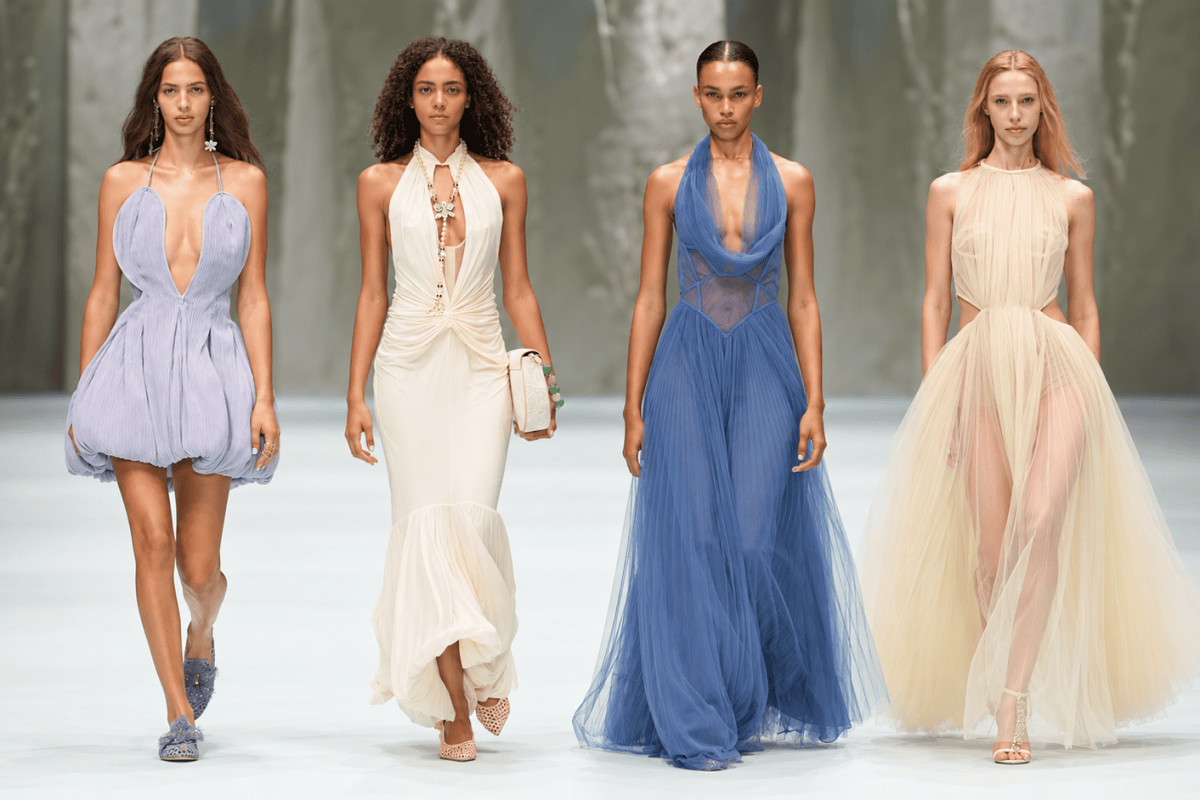
It is almost a garden that has stepped into the wardrobe. Flowers – printed, embroidered and appliquéd – run across dresses, trousers and denim; they appear on hems, on surfaces and as three-dimensional elements, together with lace, fringes, weaves and light fabrics. The palette moves from white and ivory to pink, lilac, light blue, yellow, olive green and brighter tones, while the silhouettes alternate balloon minidresses, long draped gowns, fluid trousers, light suits and deep necklines.

Cavazza Facchini works a great deal on the contrast between construction and softness. Some garments have almost sculptural shapes, others follow the body with greater fluidity; denim is treated as a decorative surface, while sheer fabrics and layering make even the most complex looks feel lighter.

Looking at the whole, a precise choice also emerges: this does not seem to be a collection designed mainly for everyday office life. Its center of gravity is closer to a resort and eventwear wardrobe – occasions, travel, evenings, ceremonies and moments when a dress needs to have presence. Sheer fabrics, necklines, embroidery, lace and important volumes all point in this direction, and it is hard to think it is accidental: it looks rather like a very conscious stylistic choice.

Genny thus builds a declared femininity, romantic but not fragile, decorative but not heavy. A collection designed to be seen, remembered and above all worn in those moments when the dress has to become part of the scene.


GALLERY


Discover more of Sara’s World

Sara Dal Monte

Sara Dal Monte
Digital Journalist | Photographer | Art Director
Los Angeles • Sure-Com America
Instagram
X
Facebook
Facebook 2
Facebook Page

ANTONIO MARRAS, A HANDCRAFTED COLLECTION MADE OF MEMORY

Once again, Antonio Marras does not simply stage a collection. He builds a world and then lets the clothes move through it. For Spring Summer 2027, the Giardino Vincenzo Muccioli in Milan becomes almost a piece of Sardinia transported into the city: a long table, the remains of a celebration, flowers, fruit, characters, memories. The title is Nozze di un Mezzogiorno di Mezz’Estate (A Midsummer Noon’s Wedding), but the wedding is above all a pretext to tell what remains when the party is over and life begins again.

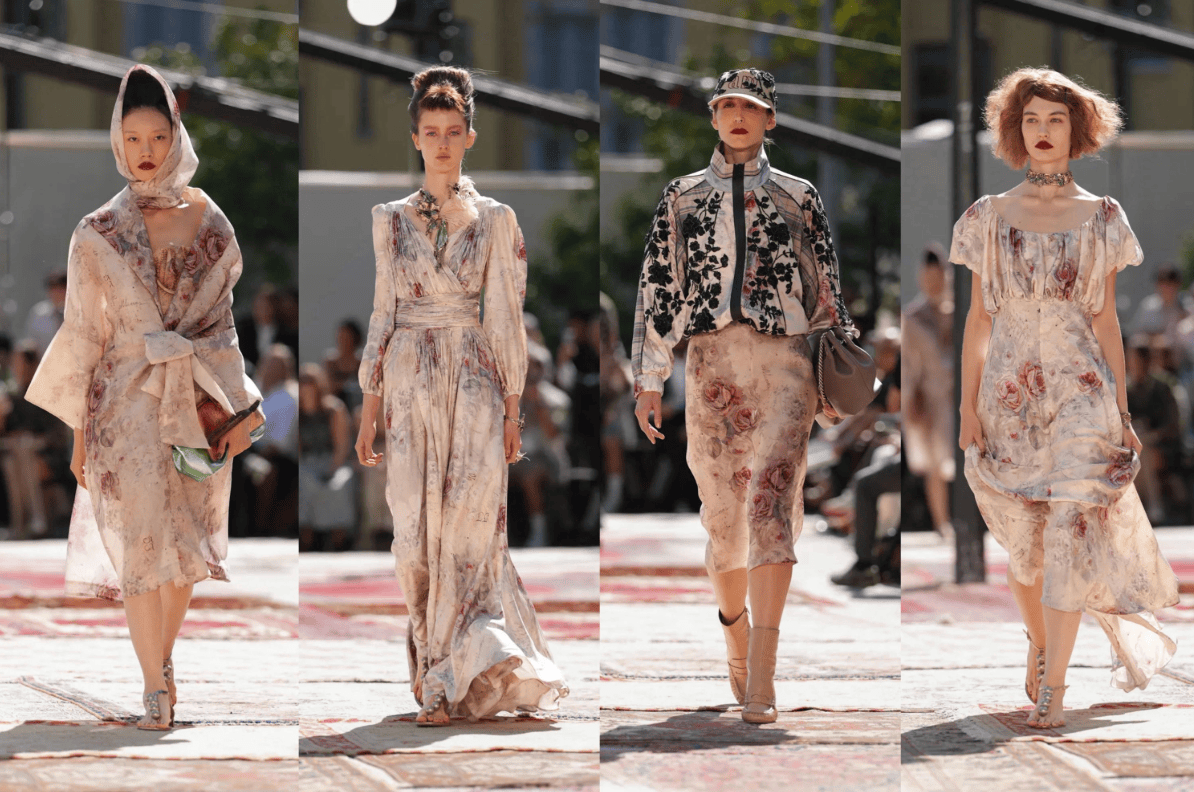
The clothes seem to come from exactly there, from the day after. They are not perfect, and they don’t want to be. They have something lived-in about them, as if they had absorbed an entire night, the scent of myrtle, the sea salt, a wine stain, a crease left in the fabric. Marras works on memory once again, but without turning it into nostalgia: he takes lace, chiffon, organza, brocade, jacquard, embroidery, patches and layering, and brings them into a fashion that feels very much of the present, where the handcrafted gesture still carries real weight.

It is a full, layered collection, at times almost disorderly, and that is precisely what makes it recognizable. Stripes meet flowers, camouflage lives alongside more delicate materials, denim sits next to silk, while the colors move from honey to sand, from powder pink to military green and all the way to black. Nothing seems truly isolated: every element relates to the one beside it, just as it happens in families, at celebrations, in the stories Marras keeps telling season after season.

There is one aspect I consider central to his work: Marras has never been afraid of imperfection. On the contrary, that is often where he finds the most interesting part of beauty. An edge, a layer, a surface that is not completely clean, an embroidery that seems to carry a story with it. Once again, his language speaks through what others might try to correct. With him, the flaw is not erased: it becomes character.

The collaboration with Giovanni Raspini reinforces this idea even further. Fifty-three pieces of jewelry created for the show enter the looks as almost ritual objects, in burnished bronze, stones, mother-of-pearl and references to Sardinian culture. Not simple accessories, but presences within the story, small talismans that complete the feeling of something handed down, gathered and preserved over time.

Perhaps this is precisely Antonio Marras’s strength: while so much of fashion is constantly searching for a new image to show, he keeps searching for stories to tell. And the clothes, even before they are looked at, seem to have already lived something.


GALLERY


Discover more of Sara’s World

Sara Dal Monte

Sara Dal Monte
Digital Journalist | Photographer | Art Director
Los Angeles • Sure-Com America
Instagram
X
Facebook
Facebook 2
Facebook Page

FENDI SPRING SUMMER 2027 BY MARIA GRAZIA CHIURI

Today’s show was one of the appointments I was most looking forward to at this Milan Fashion Week. I wanted to understand where Maria Grazia Chiuri is taking Fendi after her return to the house and her debut last February. Having seen the collection, my impression is quite clear: I see a Fendi very different from the one we have known over the past decades. I may be wrong, of course, and it is still too early to tell where this path will lead, but the distance from some of the house’s historic codes seems evident to me.

To me, Fendi has always been material, color, fur, irony, sensuality, Rome. Over more than half a century Karl Lagerfeld built an extraordinarily powerful language; after him, Silvia Venturini Fendi and Kim Jones interpreted it in different ways, while keeping that thread recognizable. With Maria Grazia Chiuri I sense something different. Not necessarily better or worse: simply another register. Her debut had already shown a greater focus on silhouette, on volume and on an overall more measured image. Today that direction appears even clearer.

Chiuri brings much of her own way of thinking about fashion into Fendi: the relationship between body and garment, freedom of movement, less rigid constructions, the dialogue between masculine and feminine and, above all, the work of hands, of the atelier, of material. The clothes follow the body, sometimes revealing it, at other times wrapping it; volumes shift as the models walk, layering lightens the constructions and femininity is never declared too overtly. It is a collection seeking a balance between form and freedom.

But while watching the show I kept asking myself one question: is Maria Grazia Chiuri entering the world of Fendi, or is Fendi increasingly entering the world of Maria Grazia Chiuri? A creative director must leave their mark, otherwise there would be no point in entrusting them with a house. But Fendi has more than a hundred years of history and a very strong visual memory. It is not just a logo. It is a way of treating material, of using color, of shaping a woman, and even of playing with that particular Roman opulence that has always been part of its character.

Today’s collection has research, construction, craft and its own precise idea of a woman. That is not in question. Personally, though, in front of some looks, if I removed the Fendi name I would struggle to recognize the house right away. And this is exactly what makes Maria Grazia Chiuri’s journey interesting: seeing how far she will take this transformation, and how much of the codes we know will continue to live within the Fendi she is building.

Perhaps it is still too early to draw a conclusion. Today I clearly see Maria Grazia Chiuri’s hand. Now I want to see how that hand will manage to dialogue with Fendi’s identity.

GALLERY


Discover more of Sara’s World

Sara Dal Monte

Sara Dal Monte
Digital Journalist | Photographer | Art Director
Los Angeles • Sure-Com America
Instagram
X
Facebook
Facebook 2
Facebook Page

JIL SANDER, WHEN MINIMALISM STOPS BEING RIGOR AND BECOMES MOVEMENT

This morning Jil Sander presented in Milan its Spring/Summer 2027 collection, women’s and men’s, designed by Simone Bellotti. The show was scheduled at 10:30 on the second day of Milan Fashion Week.

I chose these looks because, looking at them, the direction Bellotti is giving the house seems clear to me. Jil Sander’s minimalism remains, but it is no longer just subtraction. It gains volume, movement, a few deliberate imperfections. It is a purity that does not give up the ability to surprise.

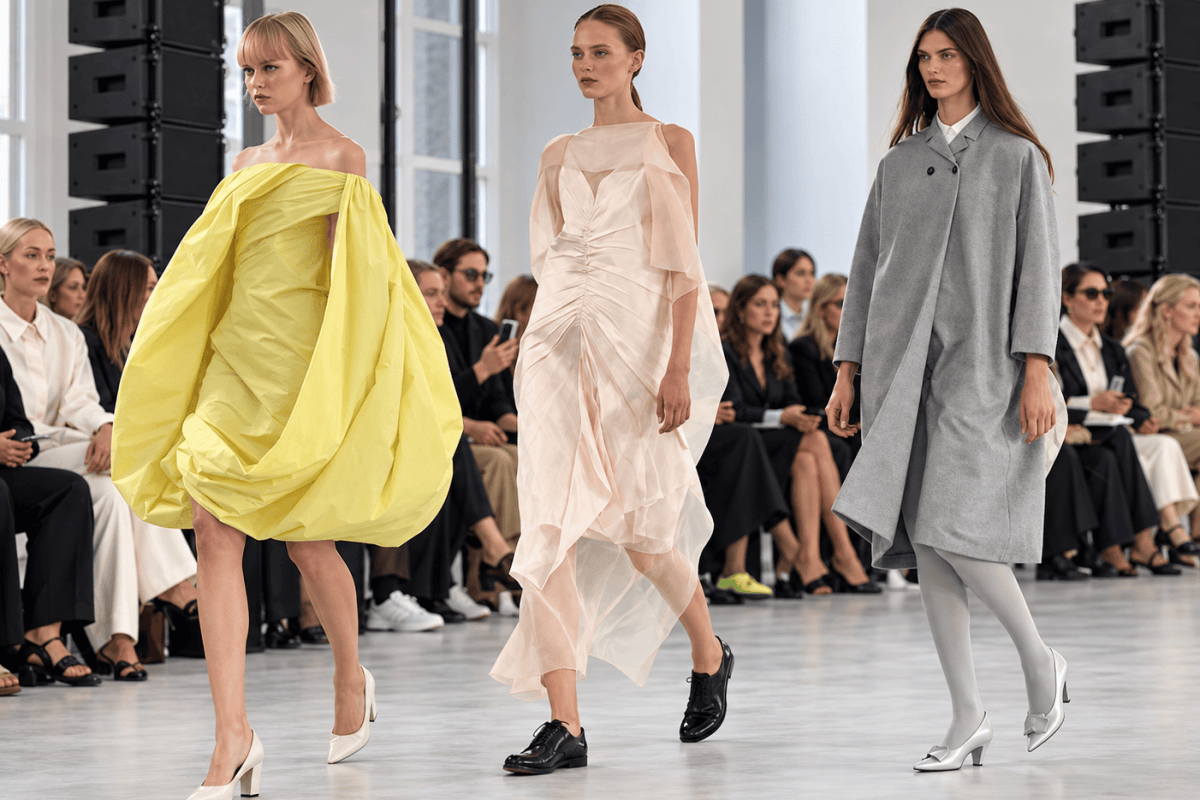
The grey coat perhaps expresses this idea better than any other piece. A wide, almost severe line, an essential construction, very few visible elements. And yet you only need to look at the proportions, the way it falls on the body and the pairing with very pale tights and almost old-fashioned feminine shoes to understand that behind that simplicity there is precise work. In the men’s look the same principle becomes darker and more vertical: an overcoat and wide trousers build a lean, contemporary figure, with no need to add anything else.

Then the yellow arrives and completely changes the register. A dress that seems built directly through the fabric: large amounts of material wrap the body, fall from the shoulders, gather at the front and open up again. It is not the color doing all the work. It is the volume. And precisely within a house identified for decades with minimalism, this controlled abundance becomes even more interesting.

I was also struck by the very pale, almost impalpable dress. Here Bellotti works in exactly the opposite way: sheer fabrics, gathers, layering and a construction that follows the body without imprisoning it. The black men’s shoes beneath such a light dress deliberately break any romantic temptation. It is one of those details that make you understand the collection is not looking for an easy kind of beauty.

And then there is that almost unexpected encounter between the bright, textured top, crossed by green, red and metallic reflections, and the skirt built like a landscape. It is probably the look furthest from the conventional image many people still have of Jil Sander. That is precisely why it works: it shows that a strong identity can afford to step outside its own boundaries without losing recognizability.

Finally, the light blue shirt with the white miniskirt. Seemingly nothing could be simpler. But it is the proportions that transform it: the men’s shirt, the clean-cut skirt, the grey tights and that white shoe with a small heel and a bow. Almost a uniform, but completely rewritten.

When he joined Jil Sander, Bellotti had already spoken of seeking a balance between structure, tailoring and classicism on one side, and modernity and lightness on the other. It is a path that began with his debut for the house in 2025 and that today appears freer.

This is what I find interesting about today’s Jil Sander: it does not destroy minimalism, it sets it in motion. The rigor remains, but it is no longer a cage. The body enters the project, the fabric breathes, color breaks the silence. And when a brand manages to change without losing its own grammar, then change truly begins to make sense.

GALLERY


Discover more of Sara’s World

Sara Dal Monte

Sara Dal Monte
Digital Journalist | Photographer | Art Director
Los Angeles • Sure-Com America
Instagram
X
Facebook
Facebook 2
Facebook Page

VOGUE WORLD MILAN: THE FUTURE IS “MADE BY HAND”

Vogue World travels from one fashion capital to another. After New York, London, Paris and Los Angeles, it has arrived in Milan, in the Galleria Vittorio Emanuele II. I have already written about the faces and encounters of the evening. Today I want to pause on the words chosen for this edition: Where The Future Is Made By The Hand. The future is made by hand.

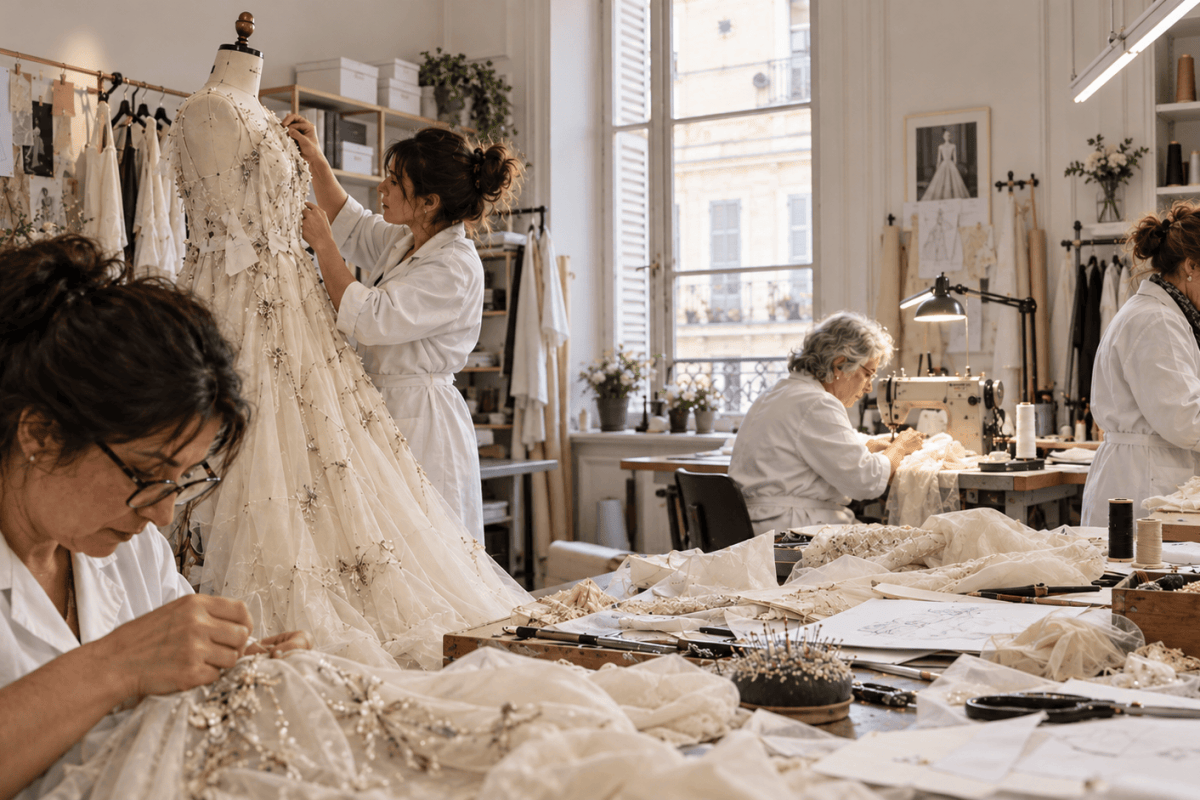
To me it seems a simple and precise sentence. Because a garment begins with an idea, but it takes shape when someone chooses a fabric, draws a pattern, cuts, sews, fits, corrects. Sometimes unpicks the seams and starts again. The fashion we see on the runway is also born in those moments, far from the lights of the catwalk.

And it does not end in the workshop. Around a garment work seamstresses and tailors, pattern makers, embroiderers, textile companies and manufacturers. There are the designers who give it direction, the press that tells its story, the agents, the showrooms and the stores that bring it to the public. It is a network I also know through my work with B.E. Management. At the end of this journey there is a person who chooses to buy a garment: they often do not see all the hands that made it possible, but they are buying their work too.

For Italy, this supply chain has a value that goes beyond the beauty of the product. It keeps skills, businesses and industrial districts alive; it creates jobs and preserves a know-how that cannot be learned in a single season. That is why celebrating handmade craftsmanship in front of an international audience is an important gesture. The next step is to ensure that these crafts have continuity: workshops where people can learn, companies able to pass on experience, young people who can imagine their future there. You cannot ask children to carry on a craft if that craft offers them no prospects.

Last night Milan showed the world one of the most beautiful images of its fashion. The title chosen by Vogue stays with me because of what it asks us to do after the show: to look closely at those who build that future, one garment at a time.


Discover more of Sara’s World

Sara Dal Monte

Sara Dal Monte
Digital Journalist | Photographer | Art Director
Los Angeles • Sure-Com America
Instagram
X
Facebook
Facebook 2
Facebook Page

PRADA, THE LAND OF WOMEN IN SKIRTS

Looking at Prada’s new collection, one image came straight to mind: the land of women in skirts. Different women, different skirts, different ways of being feminine. And maybe that’s what struck me most about Miuccia Prada and Raf Simons’ collection.

For quite some time, I had the impression that in their work together femininity had been cooled down, at times almost played down, leaving plenty of room for research, for concept, and for that intellectual provocation that belongs so deeply to Prada. This time, though, I have to change my mind. Women are back at the center, and they return through a garment that seemed to have almost lost its place: the skirt.

They’re everywhere. Long, short, straight, full, sheer, embroidered, pleated, with deep slits, light or structured. It’s like truly stepping into this imaginary land of women in skirts, where there is no single way of being a woman. That’s where the collection gets interesting, because Prada doesn’t bring back the skirt to take us backward, nor to offer a predictable femininity. It uses the skirt to tell the stories of different women.

I also like the way the boyfriend element enters this universe, that masculine touch that deliberately interrupts the narrative: a looser shirt, a jacket, a proportion almost borrowed from his wardrobe. The result doesn’t cool the woman down. Quite the opposite. The contrast makes the skirt stand out even more, and with it the body, the movement, the sensuality.

Slits, sheer fabrics, and embroidery do the rest, without turning everything into a loud statement. The body appears, disappears, is left to be glimpsed. There is sensuality, but it doesn’t need to prove itself at every turn. And this may be where this collection convinces me more than others I’ve seen in recent years.

Of course, it’s still Prada, with its very own way of putting together things that seemingly shouldn’t go together. Colors, materials, proportions, deliberately odd details. Miuccia Prada has always had this talent: slipping in something that disturbs just when everything risks becoming too beautiful, too perfect, too predictable. Raf Simons brings his own vision into this language, and the result remains instantly recognizable.

But this time, walking through this land of women in skirts, I had a different feeling. I saw less distance and more body, less coldness and more femininity. Without nostalgia, and above all without going back to an outdated idea of women.

Perhaps this was exactly the shift I’d been waiting for from Prada.

The skirt is back. But above all, the woman who wears it is back.


Discover more of Sara’s World

Sara Dal Monte

Sara Dal Monte
Digital Journalist | Photographer | Art Director
Los Angeles • Sure-Com America
Instagram
X
Facebook
Facebook 2
Facebook Page

VOGUE WORLD MILAN 2026: TONIGHT I SAW AN IMAGE I HAD IMAGINED COME TO LIFE

On September 4, while writing about Milan Fashion Week, I imagined a major fashion show taking place inside the Galleria Vittorio Emanuele II. I did so for a very simple reason: I believe it is one of Milan’s most powerful images, perhaps one of the locations that best embodies Italian fashion. The Galleria has beauty, history, architecture and a natural sense of theatre. It is Milan in one of its most recognizable forms.

That is why I created exactly that scene for the cover of the article. Tonight, watching Vogue World transform the Galleria into a spectacular stage for fashion, I immediately thought back to what I had written on September 4.

Of course, Vogue World had been conceived, planned and organized long before then. There is no connection between the two things. But seeing that same vision of Milan I had imagined a few weeks ago come to life — on an entirely different scale and at another level — was quite something.

And after seeing the Galleria tonight, I am even more convinced of one thing: this is one of the places in Milan where fashion should take to the runway.

Then the show began, and what moved me most was not simply seeing top models, actresses, actors, singers, dancers and athletes walk through one of Milan’s most beautiful landmarks. It was seeing alongside them the artisans, workers and people who represent that long and complex supply chain without which fashion simply could not exist. Behind every garment there are hands, skills, fabrics, workshops, pattern makers, seamstresses, technicians and companies.

There is an enormous world that normally remains behind the scenes, working every day so that this industry can continue to create beauty, culture, employment and value. Vogue World Milan had the merit of bringing that world into the spotlight as well, telling the story of Made in Italy through the relationship between human craftsmanship, industry, creativity and innovation.

Fashion is often described as superficial, even frivolous. Part of it certainly can be, but stopping there means failing to understand its language. The way we dress is also a way of communicating something about ourselves, of showing others how we choose to present ourselves and, sometimes, simply of making ourselves feel better. Clothes do not define who we are, but they can contribute to the way we choose to express it.

And then there is beauty — perhaps the word that has stayed with me more than any other tonight: the Galleria Vittorio Emanuele, the music, the dance, the models, the artists and, above all, the human work that makes all of this possible.

Yet perhaps never more than now should we remind ourselves just how precious and fragile all of this is. We are living through days in which words we thought belonged to history books have returned: war, borders, missiles, rearmament. Images reach us every day from every corner of the world, and we even risk becoming accustomed to them. Then, for one evening, beneath the glass vaults of Milan’s Galleria, something completely different passes before our eyes: people who have built, sewn, designed, sung, danced and performed.

People who have devoted time, intelligence and talent to creating something beautiful. It has taken generations to build culture, craftsmanship, knowledge, cities like Milan and industries such as Italian fashion.

Losing all of it, however, could take far less.

Perhaps that is also why the Galleria looked even more beautiful to me tonight.


Discover more of Sara’s World

Sara Dal Monte

Sara Dal Monte
Digital Journalist | Photographer | Art Director
Los Angeles • Sure-Com America
Instagram
X
Facebook
Facebook 2
Facebook Page

SEPTEMBER, FASHION RETURNS TO THE RUNWAY. BUT THE MARKET DEMANDS ANSWERS

September has never been just about Fashion Week. It’s the moment when international fashion returns to the spotlight. More importantly, it’s when the gap between storytelling and actual sales gets measured.

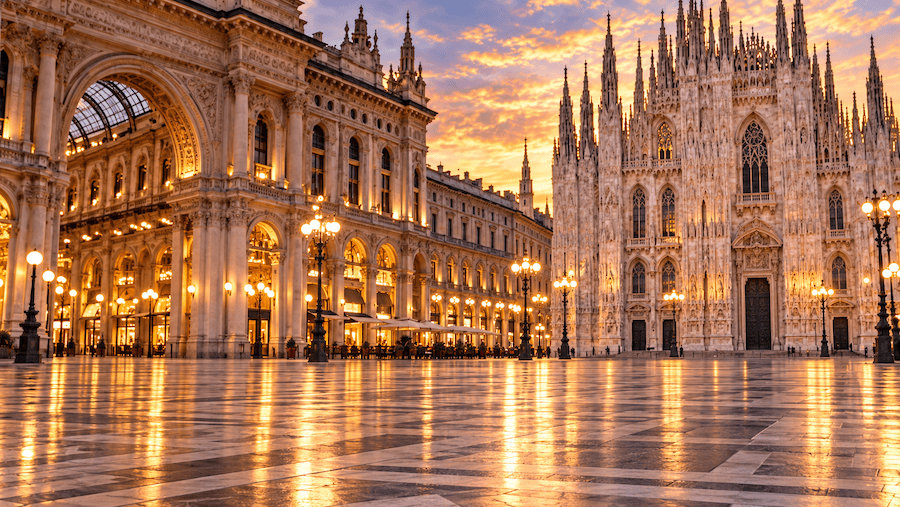
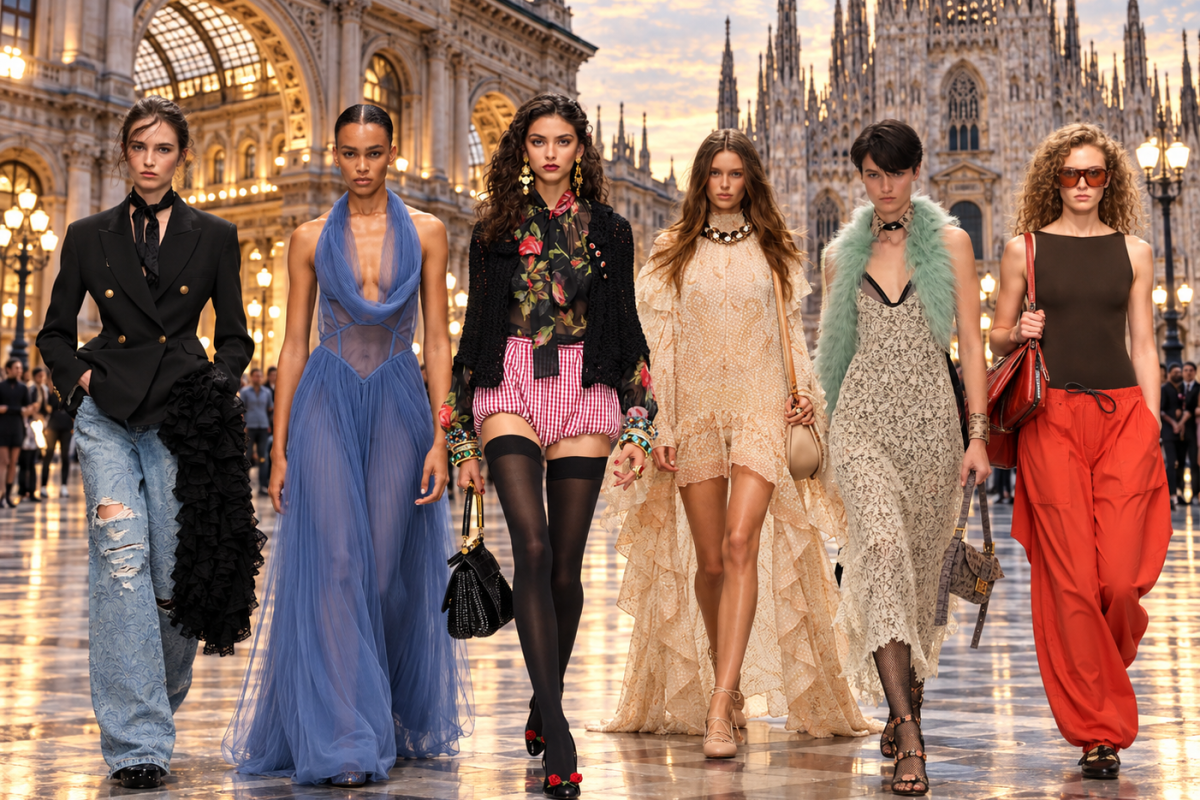
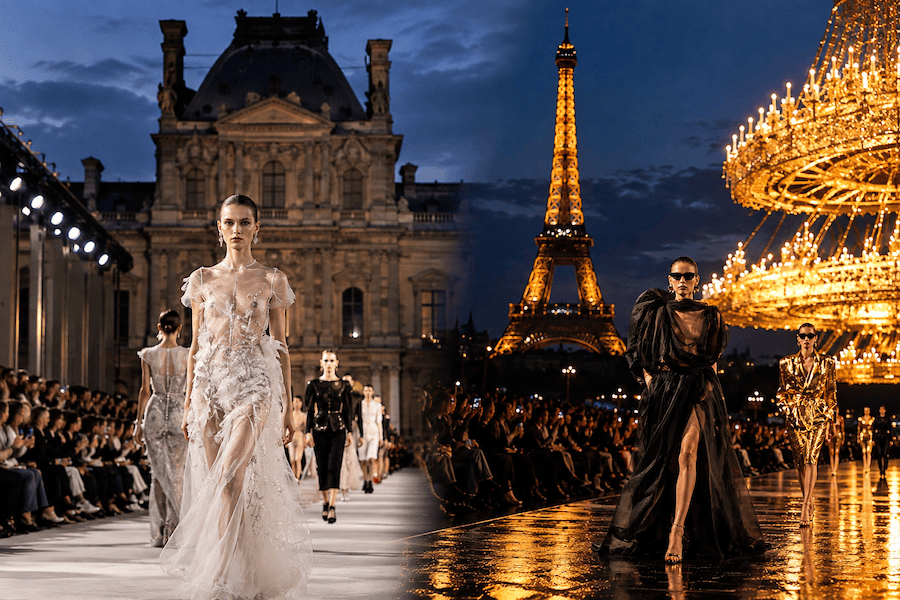
The image I created for the cover is no accident. It’s deliberately descriptive. It illustrates this article, but also a personal wish: to finally see a real runway show in Galleria Vittorio Emanuele II, transformed into a space entirely dedicated to fashion.

New York, London, Milan and Paris will present their Spring/Summer 2027 collections. This reopens the long season of shows, presentations and events that captures the entire industry’s attention for weeks. But this time, the real interest won’t just be about what we’ll wear in six months. It will be about which brands still have a clear direction. And which ones are still trying to find it.

Because fashion, before being communication, remains product, business, distribution, margins and the ability to create desire. The runway can amplify all of this. But it cannot invent it. And that’s exactly where September gets interesting.

In recent years, we’ve seen constant changes in creative directions. Relaunches. Repositionings. High-visibility campaigns. An almost relentless production of images. Everything moves faster. But the market keeps reminding us of a simple rule: being visible doesn’t necessarily mean being desirable. And being desirable doesn’t automatically mean selling.

A collection’s success isn’t measured only by image impact or the volume of content it generates. It’s measured by its ability to restore coherence to the brand. Today’s consumer sees everything. Compares everything. Has access to information that didn’t exist just a few years ago. They figure out quickly when a brand’s story aligns with the product. And when communication is just compensating for a lack of identity.

That’s also why Fashion Weeks are changing function. They remain spectacle, image, relationship-building. But they’ve also become a public test of brand strategy. A new creative direction, a repositioning, an attempted relaunch—all are observed simultaneously by buyers, press, investors, clients and the public.

Milan, in this sense, remains one of the most interesting observatories. Its strength continues to lie in the intersection of creativity and industry. Behind the Italian runway exists a structure made of companies, supply chains, manufacturing, distribution and expertise. That’s why the question can’t just be whether a collection is beautiful. It must be whether it strengthens brand identity, generates a credible product and builds value over time.

Gucci will inevitably be one of the most watched. Demna’s arrival has opened a new chapter. The point won’t just be seeing what aesthetic he brings to the brand. It will be understanding whether this new identity can turn into desirability—and then into results. But Gucci is just the most visible case of a much broader phenomenon.

The constant movement of creative directors in recent years tells the story of a system seeking new balance. The designer remains central. But today that role operates within a much more complex structure. Creativity, product, market and management must work together. Changing a brand’s creative face is no longer enough to automatically change its destiny.

New York, London, Milan and Paris will naturally continue to represent four different fashion cultures. New York retains its ability to merge fashion, business and pop culture. London remains a laboratory where new languages often emerge. Milan continues to express the relationship between style and industry most clearly. Paris maintains the great symbolic and commercial power of international luxury.

But perhaps this year, it will be even more interesting to observe what they have in common.

All must confront the same problem: staying relevant in a market saturated with images and constantly bombarded by new messages. Communication has increased enormously. But precisely for this reason, attention has become more fragile. A show can dominate social media for twenty-four hours and disappear the next day. A collaboration can go viral without actually building value. A new creative director can generate plenty of curiosity. But curiosity is not yet brand loyalty.

Branding, ultimately, is measured afterward. When the show’s effect has faded. When the campaign is no longer new. When what remains is understanding what the consumer actually retained about the brand. That’s where identity, recognition and perceived value matter.

It’s also the principle I try to apply in my work. When I work with a brand, I’m not simply interested in increasing visibility. I focus on elevating the narrative. Enriching it. Imprinting it with personality and identity. Because storytelling, when intelligent, sophisticated and aligned with positioning, becomes one of the most effective forms of branding. It’s not just about getting people to talk about a brand. It’s about deciding how it enters the mind of those who observe it.

And perhaps that’s the most interesting point about September. Not so much what we’ll see on the runways. But what we’ll understand by watching them. Who is truly building a new phase. Who is just changing image. And who can still transform creativity and product into real desire.

Because today, a Fashion Week tells us much more than a season. It reveals the health of brands. And in some ways, the direction the entire fashion system is taking.


Discover more of Sara’s World

Sara Dal Monte

Sara Dal Monte
Digital Journalist | Photographer | Art Director
Los Angeles • Sure-Com America
Instagram
X
Facebook
Facebook 2
Facebook Page