TOM FORD SS27 AT PFW: THE STRENGTH OF ITS LANGUAGE

2 MIN READ

Tom Ford’s Spring Summer 2027 starts from one precise point: recognizability. Haider Ackermann does not try to erase the language of the House, nor to use it as a mere quotation. He takes it, moves through it and carries it into his own sensibility, keeping that tension between elegance and sensuality that has always belonged to Tom Ford.

The collection works above all on line. The body returns to the center, for both men and women, but without gratuitous exaggeration. Jackets are sharp, trousers fall clean, shirts open up and grow lighter, to the point of almost becoming shirt-jackets. On the women’s side come micro-shorts, bodysuits, tops reduced to the essentials and sheer fabrics, without turning provocation into the collection’s only argument.

It is a controlled sensuality, built through proportions.

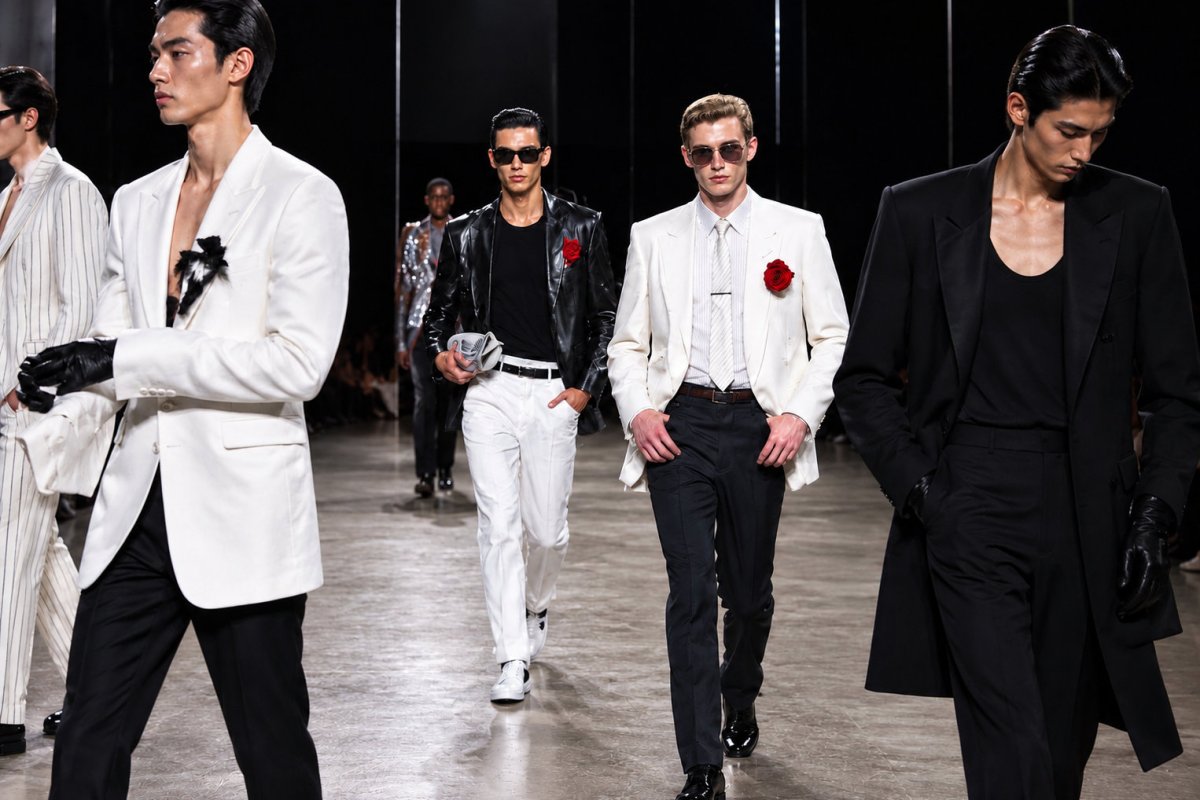
Black dominates, accompanied by white and red, often used as an accent: a flower, a detail capable of interrupting the rigor of the composition. Then come military green, denim, patent leather and pinstripe. Different materials and registers coexist without compromising the overall coherence.

Menswear too keeps that almost cinematic confidence that belongs to the Tom Ford imagery. White and black suits, leather, dark sunglasses, shirts worn open, tailored trousers alternating with more relaxed constructions. This is not a man stiffened by tailoring, but a man who wears it with ease.

And then there is the woman. Strong, self-aware, extremely feminine even when she borrows elements traditionally belonging to the male wardrobe. The contrast is what makes it interesting: the more the figure takes on masculine codes, the more her femininity seems amplified. In some passages the imagery of Helmut Newton vaguely comes to mind, with those confident, sophisticated and sensual women even inside a rigorous suit.

Ackermann succeeds above all in one difficult thing: making his own hand felt without forcing Tom Ford to become something else.

In a moment of fashion in which many creative directors seem to seek change through rupture, here almost the opposite happens. Change comes from working inside an already strong language, intervening on proportions, materials and attitude without erasing its recognizability.

And this is probably the most evident result of the show: men and women can change shapes, materials and proportions, yet they continue to belong to the same universe.

GALLERY

click on the images to enlarge


Discover more of Sara’s World

Sara Dal Monte

Sara Dal Monte
Digital Journalist | Photographer | Art Director
Los Angeles • Sure-Com America
Instagram
X
Facebook
Facebook 2
Facebook Page

GUCCI SS27: WHEN EXASPERATION BECOMES LANGUAGE

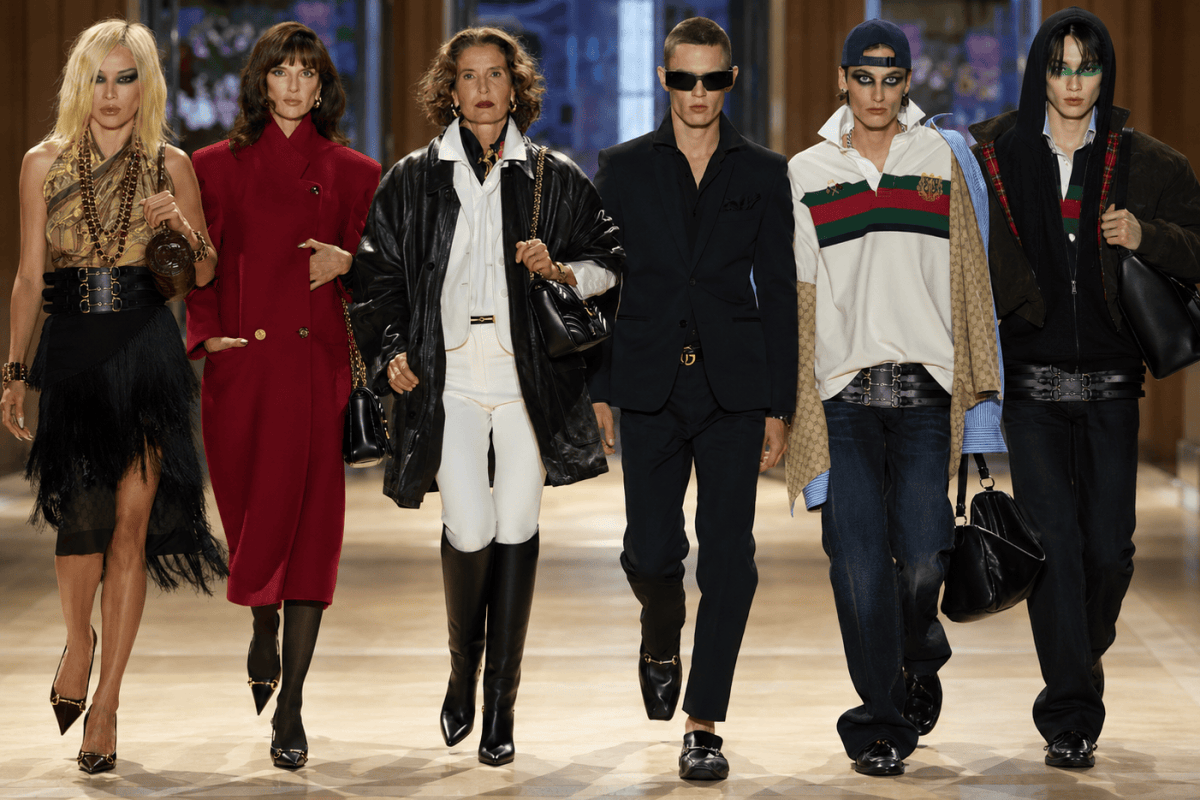
I swear I watched this show several times, because I wanted to understand where Demna wanted to take Gucci. In the end I found a key, and it is very clear: exasperation. Everything is pushed to the limit – proportions, volumes, the body, the very way an image is built. Knitwear becomes enormous and is worn by very thin boys; jackets either widen until they deform the figure or become tight, dry, almost constricting. In menswear especially, the body seems constantly corrected, shifted, diminished, as if the silhouette had to lose its balance in order to gain an identity.

And this is exactly where my problem with this collection begins. Because to exasperate means to bring something to a maximum level of tension, and after tension there necessarily comes a breaking point. Here, instead, I have the feeling that this tension has become the very language of the house, a grammar made of excess, deformation, citation, provocation, archive and constant contrasts, without it ever becoming fully clear what the point of arrival is.

Gucci comes from a different culture. It comes from precision, from construction, from an almost obsessive attention to detail, from leather, from accessories, from the ability to make a jacket, a bag or a shoe desirable without necessarily turning them into a statement. Demna takes this heritage and forces it, stretches it, shifts it, brings it into his own world. His signature is visible, very much so. But precisely because it is so visible, the question becomes inevitable: how much of Gucci remains, and how much are we simply watching Demna applied to Gucci?

In menswear the doubt is even stronger. I see a very young male figure, built almost on a single type of physique and attitude. Targeting that audience is fine – it would be absurd to deny it – but Gucci does not sell only to twenty-year-olds. It also sells to men of forty, fifty, sixty, to a client who may want to be contemporary without turning into a character. And here I struggle to understand where that man has gone.

Then comes the “family”: the boy, the girlfriend, the mother, the aunt, the older lady. I fully understand the desire to tell the story of a transversal brand, capable of crossing generations, but I keep asking myself what the story really is. Because if the common thread is simply taking different eras, different codes, archive pieces, Nineties sensuality, Seventies elements, Eighties volumes and putting them back together by deforming them, then we are not looking at a new vision: we are looking at a continuous reworking of what we have already seen.

I remain puzzled by the womenswear too. Sensuality is part of Gucci’s history and no one questions it, but there is sexy and sexy. There is a sensuality built on proportion, on cut, on a body that is suggested, and there is another that constantly needs to show itself. Here the second path is often chosen. It is a precise choice, but it does not always become elegance, at least not for me.

And so I return to the question I have been asking myself for some time: what are they trying to do with Gucci? Because this is not a small independent label that can afford to turn every collection into an act of protest or a conceptual exercise. This is Gucci. It is a global brand, with a history, a market, clients, investors and an evident problem of desirability to rebuild.

Destroying everything to see what happens next can also be a creative strategy. In fashion it has happened many times, and sometimes it has worked. But destruction alone is not a project. At some point you also have to build something the public wants to desire, wear, buy and recognize as new.


GALLERY


Discover more of Sara’s World

Sara Dal Monte

Sara Dal Monte
Digital Journalist | Photographer | Art Director
Los Angeles • Sure-Com America
Instagram
X
Facebook
Facebook 2
Facebook Page

JIL SANDER, WHEN MINIMALISM STOPS BEING RIGOR AND BECOMES MOVEMENT

This morning Jil Sander presented in Milan its Spring/Summer 2027 collection, women’s and men’s, designed by Simone Bellotti. The show was scheduled at 10:30 on the second day of Milan Fashion Week.

I chose these looks because, looking at them, the direction Bellotti is giving the house seems clear to me. Jil Sander’s minimalism remains, but it is no longer just subtraction. It gains volume, movement, a few deliberate imperfections. It is a purity that does not give up the ability to surprise.

The grey coat perhaps expresses this idea better than any other piece. A wide, almost severe line, an essential construction, very few visible elements. And yet you only need to look at the proportions, the way it falls on the body and the pairing with very pale tights and almost old-fashioned feminine shoes to understand that behind that simplicity there is precise work. In the men’s look the same principle becomes darker and more vertical: an overcoat and wide trousers build a lean, contemporary figure, with no need to add anything else.

Then the yellow arrives and completely changes the register. A dress that seems built directly through the fabric: large amounts of material wrap the body, fall from the shoulders, gather at the front and open up again. It is not the color doing all the work. It is the volume. And precisely within a house identified for decades with minimalism, this controlled abundance becomes even more interesting.
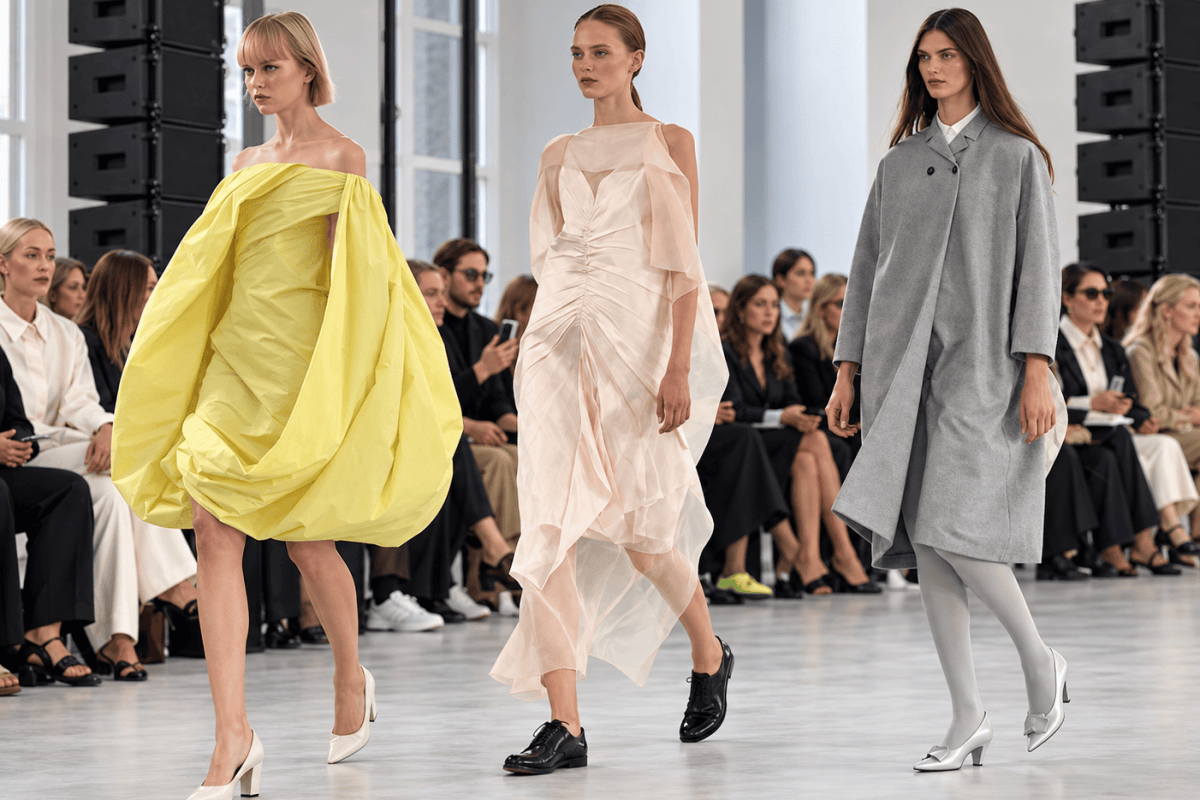
I was also struck by the very pale, almost impalpable dress. Here Bellotti works in exactly the opposite way: sheer fabrics, gathers, layering and a construction that follows the body without imprisoning it. The black men’s shoes beneath such a light dress deliberately break any romantic temptation. It is one of those details that make you understand the collection is not looking for an easy kind of beauty.

And then there is that almost unexpected encounter between the bright, textured top, crossed by green, red and metallic reflections, and the skirt built like a landscape. It is probably the look furthest from the conventional image many people still have of Jil Sander. That is precisely why it works: it shows that a strong identity can afford to step outside its own boundaries without losing recognizability.

Finally, the light blue shirt with the white miniskirt. Seemingly nothing could be simpler. But it is the proportions that transform it: the men’s shirt, the clean-cut skirt, the grey tights and that white shoe with a small heel and a bow. Almost a uniform, but completely rewritten.

When he joined Jil Sander, Bellotti had already spoken of seeking a balance between structure, tailoring and classicism on one side, and modernity and lightness on the other. It is a path that began with his debut for the house in 2025 and that today appears freer.

This is what I find interesting about today’s Jil Sander: it does not destroy minimalism, it sets it in motion. The rigor remains, but it is no longer a cage. The body enters the project, the fabric breathes, color breaks the silence. And when a brand manages to change without losing its own grammar, then change truly begins to make sense.

GALLERY


Discover more of Sara’s World

Sara Dal Monte

Sara Dal Monte
Digital Journalist | Photographer | Art Director
Los Angeles • Sure-Com America
Instagram
X
Facebook
Facebook 2
Facebook Page